
Automotive Local SEO: Proven Strategies for Multi-Location Businesses
Obtenez un résumé rapide de blog avec :


Running one dealership is hard enough. Running fifteen locations across six cities, each with its own competitors and its own idea of “near me”? That’s a different game. Most SEO advice assumes you’re optimizing one website for one town. It falls apart the moment you add a second location.
Buyers completely ignore an impressive flagship store sitting two towns over. They just want the lot down the street. Bolting individual branches onto a corporate site as simple afterthoughts bleeds revenue everywhere except headquarters.
Search engines demand hyper-local relevance. Mastering automotive SEO for multi-location businesses requires a radically different approach. This guide strips away the theory to reveal the actual mechanics behind scalable visibility. Expect to map local search behavior, build robust location pages that dodge cannibalization, and manage Google Business Profiles seamlessly. Let’s get every lot found.
What Is Automotive SEO for Multi-Location Businesses?
Référencement automobile for multi-location businesses is a targeted digital strategy. It pushes separate branches to the top of local search results and AI-driven platforms. Stretching one generic homepage across a dozen different markets fails miserably. Building distinct local footprints actually works. This means actively managing individual Google Business Profiles, crafting dedicated landing pages, and deploying regional keywords for every single physical address.
The corporate name provides trust. The local page catches the lead. Mastering SEO for automotive chains means treating each physical store like an independent business fighting for neighborhood traffic.
A driver hunting for nearby auto repair just wants an open service bay. They have zero interest in digging through a bloated corporate site to find a phone number. A broken-down truck on the highway demands an immediate answer. If you operate lots across several regions, solid multi-location dealership SEO guarantees the nearest branch wins the map pack the second residents search for vehicle financing, fresh inventory, or routine maintenance. Do they find your local lot first? They absolutely have to.
Boost Your Automotive Business Visibility With Proven Local SEO Strategies
The Unique Challenges of Multi-Location Dealership SEO
Single-location search strategy feels simple. One website, one map listing, one distinct target area. Optimize that single asset, and traffic naturally flows. Adding a second, fifth, or twentieth address complicates everything. Most standard marketing approaches fail spectacularly when handling automotive SEO for multi-location businesses.
Keyword Cannibalization Across Branch Locations
Picture two service bays sitting twenty minutes apart. Both locations want to rank for “brake repair near me.” Both feature landing pages targeting identical terms. Google crawls this setup and struggles to determine which page actually deserves the top spot for a specific user. Search engines prioritize clarity.
Instead of dominating two local markets, those branches quietly compete against each other. They split the ranking power. This internal cannibalization destroys SEO for automotive chains. Generic marketing advice ignores this technical threat entirely because it assumes a business only operates out of one single building.
Balancing Corporate Branding with Local Search Intent
Corporate teams face a delicate balancing act. Executives want every page to maintain strict brand guidelines. Local search algorithms demand the exact opposite. They reward pages built with neighborhood specifics—real mechanics, local community ties, and actual customer reviews.
Relying on uniform, templated pages guarantees poor local rankings. Focusing purely on local flavor risks brand consistency. Mastering automotive franchise SEO means executing a strategy that meets corporate standards while feeding local search algorithms exactly what they want.
Who Needs a Scalable Automotive SEO Strategy?
This approach works across the board for businesses managing multiple physical lots. It fits multi-rooftop dealer groups perfectly. Regional repair chains, tire shops, and quick-lube franchises rely on this exact structure to drive foot traffic. For businesses operating multiple repair locations, specialized auto repair SEO can help each branch compete for the local searches that matter. Auto body collision centers and fleet service providers with several depots also require hyper-local visibility. Operating three locations or three hundred requires the same foundational strategy. The execution simply requires advanced technical management as the map expands.
The Revenue Impact of Local Search
Consider the raw data. Missing local visibility in just one market hurts the bottom line. A blind spot loses service appointments, trade-in inquiries, and new vehicle sales to whichever competitor happens to secure the top map ranking.
Multiply that exact loss across ten underperforming locations. A massive chunk of revenue quietly slips away every single month. Buyers did not reject the service. They simply could not find the nearest address. Effective multi-location dealership SEO captures high-intent local search for automotive brands and converts it directly into showroom visits.
How Customers Search for Automotive Services Across Locations
Before building anything, you need to understand what’s actually happening on the other end of that search bar. Automotive searches split pretty cleanly into three buckets, and each one demands a different type of page.
Informational Searches
These come from people still figuring things out. “How often should I rotate my tires?” “Signs my brakes need replacing.” “Is it worth buying a certified pre-owned car?” Nobody’s ready to buy yet; they’re just trying to understand their situation. But here’s the opportunity: answer these questions well, and you plant your brand in their head weeks before they’re ready to act.
Commercial Searches
Now the intent sharpens. “Best Toyota dealer for trade-ins,” “top-rated auto body shop,” “most affordable brake repair” — these searchers are comparing. They’ve narrowed things down to a shortlist, and your service pages need to make the case for why you belong on it.
Local, High-Intent Searches
This is where the money is. “Brake repair near me.” “Tire shop open now.” “Toyota dealer [city].” Someone typing this has an active need, right now, in their specific area. If your local pages aren’t dialed in, you simply won’t show up, and it won’t matter how good your service actually is.
A quick way to think about which content should rank for what:
- Awareness-stage searches (“how to choose an auto body shop”) should point to blog content.
- Consideration-stage searches (“best tire shop for trucks”) should land on service pages.
- Decision-stage local searches (“tire shop near me”) need to hit either your homepage or, more likely, the specific location page for whichever branch serves that searcher.
Keyword Research for Multi-Location Automotive SEO
Mapping keywords for an expanding franchise requires building a massive data matrix. Mastering automotive SEO for multi-location businesses means plotting out hundreds of local search variables. Every branch needs a precise target.
Location Plus Service Combinations
Every core service must pair directly with every physical address in the portfolio. Think “oil change [City A]” right next to “oil change [Neighborhood B].” Building out these combinations gets tedious fast. Skipping this step guarantees branches fall behind. They just sit there quietly bleeding revenue while executives wonder why foot traffic dropped. Executing dedicated automotive location pages SEO for specific combinations actually wins the local market.
Branded vs. Non-Branded Searches
Don’t ignore branded searches. “Toyota of Denver” and “John’s Auto Repair” have search volume. Customers who know your brand are closer to conversion. They’re already warm. You need to capture that traffic too.
But non-branded searches drive most of your new customer acquisition. “Auto body shop near me” doesn’t mention your brand. But it’s where new customers find you. Balance your keyword matrix between branded terms (which convert better) and non-branded terms (which bring in fresh traffic).
Vertical-Specific Terms
Sales, service, and parts departments answer completely different customer needs. A user hunting for used truck inventory cares nothing about a windshield replacement quote. Stop lumping everything into one generic bucket. Build distinct keyword clusters for every specific vertical. Nailing aftersales local search intent often drives more consistent monthly revenue than showroom sales alone.
Building the Keyword Matrix
Open a spreadsheet right now. Create rows for services and columns for locations. Fill those empty cells with the exact local keyword each branch needs to target. Glamorous? Not at all. But this grid dictates the entire digital strategy. Every new landing page and content update traces directly back to this foundational document.
Watching for Overlap in Dense Markets
Operating lots close together creates a massive headache. A well-built keyword matrix helps spot territorial overlap before marketing teams write a single word of copy. Two neighboring shops cannot fight over the exact same dealership “near me” optimization terms. Force differentiation immediately. Target one page for the downtown market and aim the other squarely at a specific suburb. Making those tiny geographical adjustments early saves everyone from untangling a cannibalization nightmare six months down the line.
Real Examples Across Markets
Here’s how these intents play out differently across locations:
| Location | Informational | Commercial | Local (Transactional) |
| Austin | “how to check transmission fluid” | “best truck for towing” | “Ford service center Austin” |
| Dallas | “synthetic oil change cost” | “Michelin vs Bridgestone” | “tire shop Dallas TX” |
| Houston | “brake pad replacement guide” | “used SUV under 30k” | “Chevy dealer Houston” |
See the pattern? The informational and commercial queries stay relatively consistent across markets. The local queries change entirely. Each city needs its own set of location-specific keywords.
Proven SEO Strategies to Grow Every Location
This is where the real work happens. Six core strategies, each one addressing a different layer of what makes multi-location automotive SEO succeed or quietly fail. Let’s get started!
Location Page Structure and On-Page SEO
Every branch needs a dedicated page. Burying a weak directory listing three clicks deep kills conversions. A custom landing page lets that specific lot rank and convert on its own. Getting this foundation right drives automotive SEO for multi-location businesses.
Preventing Duplicate Content Penalties
Most franchises fail right here. A marketer builds one template. They swap the city name, update the phone number, and call the project finished. Google spots that lazy shortcut in seconds.
Branch pages demand unique content to hold their local rank. Highlight the actual staff working the floor. Detail the specific services offered at that exact garage. Call out nearby landmarks. Embed neighborhood reviews. Think about the buyer experience for a second. Would a customer find that page useful if they stripped away the corporate branding? If the answer is no, tear the page down and rewrite it.
Structuring Scalable URLs
Keep URLs clean and predictable. Use a format like:
| domain/locations/city-state/
domain/locations/city-state/service-name/ domain/locations/city-state/sales/ domain/locations/city-state/service/ |
Consistency beats cleverness every time. A clean URL framework must expand to fifty new lots without turning into a tangled mess. This logical hierarchy forms the backbone of a solid dealership group SEO strategy.
Implementing Local Business Schema
Add LocalBusiness schema to every operating branch. Never dump the markup code just once at the root domain level. Inject the street address, operating hours, local phone number, and precise service area into the code for each lot. Search engines need this structured data to verify those physical service bays operating across different zip codes.
Integrating Localized Trust Signals
Manufacturer partnerships carry weight across the entire brand. Local awards and community sponsorships must pull from that individual neighborhood instead. A glowing five-star rating from Denver buyers does nothing to persuade a skeptical customer evaluating an Austin branch. Executing true local SEO for car dealerships requires proving community worth at the street level. You have to earn their trust where they live.
Optimizing Authentic Media
Ditch the generic stock photos. Fake pictures of pristine showroom floors do zero favors. Upload real photos showing the brick-and-mortar building, the technicians, and the waiting room.
Authentic imagery builds immediate trust. Search algorithms spot recycled stock photos across templated pages. Customers notice the fake smiles too. Custom photography builds a stronger connection and drives better automotive location pages SEO results.
Mapping Accurate Service Availability
Not every branch offers every service. Pretending otherwise creates massive headaches. Does the downtown hub skip heavy truck repair while the suburban lot handles it? State that detail clearly on both pages. Listing phantom services frustrates customers and triggers nasty reviews. Wasting the sales team’s time with useless phone calls helps no one. Accuracy protects your local reputation and keeps conversion rates high.
Increase Your Local Search Rankings and Attract More Automotive Customers
Local SEO and Google Business Profile Management
If there is one battlefield where multi-location businesses either win big or completely fall apart, it is right here. Master this, and your branches dominate. Ignore it, and Google hands your traffic to the shop next door. For repair chains specifically, local SEO for auto repair shops can strengthen visibility across Maps, local search results, and service-specific searches while keeping each location’s information accurate.
Deploying Individual GBP Listings
Every physical location requires its own dedicated Google Business Profile. Never combine multiple branches into one bloated listing, and never create a pin for a location that does not physically exist.
Managing this across thirty different addresses is a full-time job. You need a centralized dashboard that lets you see all locations simultaneously. Set a rigid posting schedule to push out local updates at least weekly. Upload fresh photos for every branch every single month. Each profile demands accurate categories, specific service lists, and hyper-accurate operating hours.
Enforcing Strict NAP Consistency
Name, Address, Phone. NAP. This concept seems simple enough. At scale? It gets genuinely difficult.
Your NAP must mirror exactly across your website, each GBP, and every local directory. If your website says “Suite 200” but your GBP says “Ste 200,” Google registers a mismatch. These tiny inconsistencies confuse search engines and actively hurt your local rankings. A franchise that rebranded slightly or moved a lot two years ago often leaves a trail of messy data scattered across the web. Document a consistent format. Enforce it ruthlessly.
Executing Bulk Citation Management
Citations are mentions of your business name and address on other websites like Yelp, YellowPages, and industry directories. Managing citations one by one across fifty locations is impossible.
Smart franchises rely on Google Business Profile bulk management tools. These platforms push critical updates out across hundreds of directories simultaneously. Keep your data airtight, clean up existing inconsistencies immediately, and add new citations periodically to build local trust.
Driving Location-Specific Reviews
Reviews matter. A lot. But a five-star review on your main corporate page means nothing to a local map pack. Reviews must accumulate at each individual location.
A dealer group with 500 reviews split across two flagship stores, while the other eight branches show zero feedback, has a massive problem. Those quiet branches look entirely unproven to anyone searching locally. You must build review requests directly into the customer experience at every single lot. Send a text after service completion. Drop a QR code at the checkout desk. Call buyers two days after a major purchase.
Encourage customers to post photo reviews, as Google ranks them higher. You must also respond to every review, positive and negative, at each location. Consistent review velocity proves to algorithms that your specific branch is active and trusted.
Resolving Duplicate and Suspended Profiles
Large automotive groups run into this constantly. An old owner leaves a ghost listing behind. A well-meaning employee accidentally creates a duplicate profile. Google flags a minor inconsistency and suspends the whole listing.
These issues compound rapidly. What starts as a minor annoyance for one location turns into a recurring nightmare across fifty branches if nobody monitors the network. Assign a specific team member to audit your listings on a strict schedule. Do not wait for a catastrophic drop in traffic to notice a suspension.
Optimizing Q&A for Local Engagement
The Q&A feature inside the Google Business Profile often gets completely ignored. What a massive wasted opportunity for dealership “near me” optimization.
Seed this section with genuinely useful questions and answers specific to that exact location. Detail parking availability, clarify the walk-in policy, and specify exactly which vehicle makes that garage handles. Anyone can copy a templated location page. Fewer competitors bother maintaining the granular, hyper-local details that actually build trust for local search for automotive brands.
Content Strategy Across Multiple Markets
Stop rewriting the exact same brake repair guide for fifty different branches. That creates a massive duplicate content headache. Master automotive SEO for multi-location businesses by building smarter content frameworks. A strong marketing de contenu strategy can help the corporate site build topical authority while individual location pages focus on local, high-intent searches.
Hub-and-Spoke Content Models
Build one strong core piece of educational content. Think of it as the central hub. Then let the individual location pages link directly to that main guide.
This strategy fuels powerful internal linking. It keeps the branch pages lean while satisfying the algorithm’s hunger for topical relevance. You avoid churning out thin, repetitive articles across the entire network. Smart internal linking passes authority right where it needs to go.
Local Landing Pages Versus Blog Content
Keep branch pages transactional. Visitors just want service lists, operating hours, and a fast way to book an appointment. Put broad questions in the on-page blog. Never mix the two formats.
Stuffing a conversion-focused location page with generic educational fluff ruins the user experience. A confused visitor bounces immediately. Clear boundaries between educational articles and lead-generating map pins build a sharper dealership group SEO strategy.
Genuinely Local Content
Most marketing teams just swap the city name and hit publish. Google ignores that lazy shortcut. Write content a real resident actually finds useful.
Mention specific nearby neighborhoods. Reference actual regional driving conditions. Does a specific garage sponsor the local high school football team? Highlight that connection. This authentic hyper-local focus powers successful automotive franchise SEO. It proves real community ties. It separates a thriving location page from one the search engine filters out.
Seasonal and Regional Content Variation
A Minneapolis dealership and a Phoenix repair shop face completely different customer emergencies in January. One lot fields panicked calls about dead batteries in sub-zero ice. The other services AC units in relentless desert heat. Generic corporate blogs miss this reality entirely.
Smart marketers build region-specific content to address exact climate needs. This proves the brand actually understands the daily grind local buyers face. Tailored regional advice beats one-size-fits-all corporate fluff every time. It drives better engagement and lifts overall automotive location pages SEO.
Avoiding Thin Content Penalties
We touched on this earlier, but it is worth repeating. Thin content is your enemy. Each location page needs real substance to survive in local search for automotive brands.
Here is exactly what substance means:
- Minimum 500 words per location page
- Unique content (never copied from other branches)
- Local references (nearby landmarks, events, community connections)
- Staff information (real names, photos, and experience)
- Service details (exact prices, special offers, and guarantees)
- Customer testimonials (featuring local names and photos if possible)
This is a lot of work. But it has to be done. There is no shortcut in local SEO for car dealerships.
The Role of AI in Scaling Content
Here’s the controversial part. Can you use AI to write location pages? Yes. Should you use AI to write location pages? Yes, but carefully.
The correct approach is to use AI as a starting point. Generate a draft. Then have a human editor rewrite, localize, and fact-check every page. This gets you to 80% quality quickly. The human editor gets you to 100%.
Search algorithms detect low-quality, automated text instantly and penalize the domain. When managed correctly by human editors, AI-assisted writing becomes a legitimate scale strategy for dealership “near me” optimization.
Grow Your Automotive Business With Smarter Multi-Location Local SEO Strategies
Link Building Strategies Across Multiple Markets
Securing quality backlinks takes effort, especially when you’re trying to build authority across multiple regional markets. A structured SEO link building strategy can help the corporate domain and individual locations earn relevant authority. Doing it across a dozen different regions requires a highly structured approach. Strong backlinks remain essential for search visibility. Mastering automotive SEO for multi-location businesses requires a dual strategy. You need hyper-local links for individual branches and broader authority for the main corporate domain.
Executing Hyper-Local Link Acquisition
Each branch must pursue its own neighborhood backlinks. Think local sports sponsorships, partnerships with nearby businesses, and mentions in regional news coverage. These hyper-local links carry massive weight for map rankings. They drive far more value than generic national directories ever will. This targeted approach directly boosts automotive location pages SEO.
Building Corporate-Level Domain Authority
Alongside neighborhood outreach, the parent brand must pursue broader industry authority. Secure placements in automotive publications, leverage manufacturer partnerships, and earn national press coverage. This effort lifts the overall domain rating. A rising tide lifts all boats. Every individual branch page benefits from that corporate trust, strengthening the entire dealership group SEO strategy.
Diversifying Anchor Text Profiles
Anchor text is the actual clickable text inside a hyperlink. You need constant variety here. Too many exact-match phrases look like spam to search algorithms. Too many generic phrases miss valuable ranking opportunities. A healthy backlink profile requires a calculated mix.
For location pages, your anchors should include:
- Branded anchors: “Toyota of Denver”
- URL anchors: “https://yourdealershipwebsite. com“
- Generic anchors: “dealership website” or “visit site”
- Partial-match anchors: “Toyota dealer in Denver”
Spread these variations across all incoming links. Diversity signals natural growth and protects your local SEO for car dealerships from algorithmic penalties.
Earning Links Through Genuine Community Involvement
Sponsoring a youth baseball team, hosting a car care clinic for new drivers, or donating a vehicle inspection day for a local charity works wonders. These are genuine community events that happen to earn digital coverage, local mentions, and high-quality backlinks as a byproduct.
This organic approach ages far better than anything built just for search engines. It does double duty by generating real neighborhood goodwill while directly improving dealership “near me” optimization.
Technical SEO for Large Multi-Location Sites
A messy backend structure destroys even the best content strategy. Executing proper SEO technique ensures search engines index and rank every single dealership branch exactly where it belongs.
Site Structure That Supports Expansion
A website managing fifty branches needs a crystal clear hierarchy. Flat menus collapse under the weight of a regional franchise. Multi-location sites demand structured depth. Your URL framework should look exactly like this:
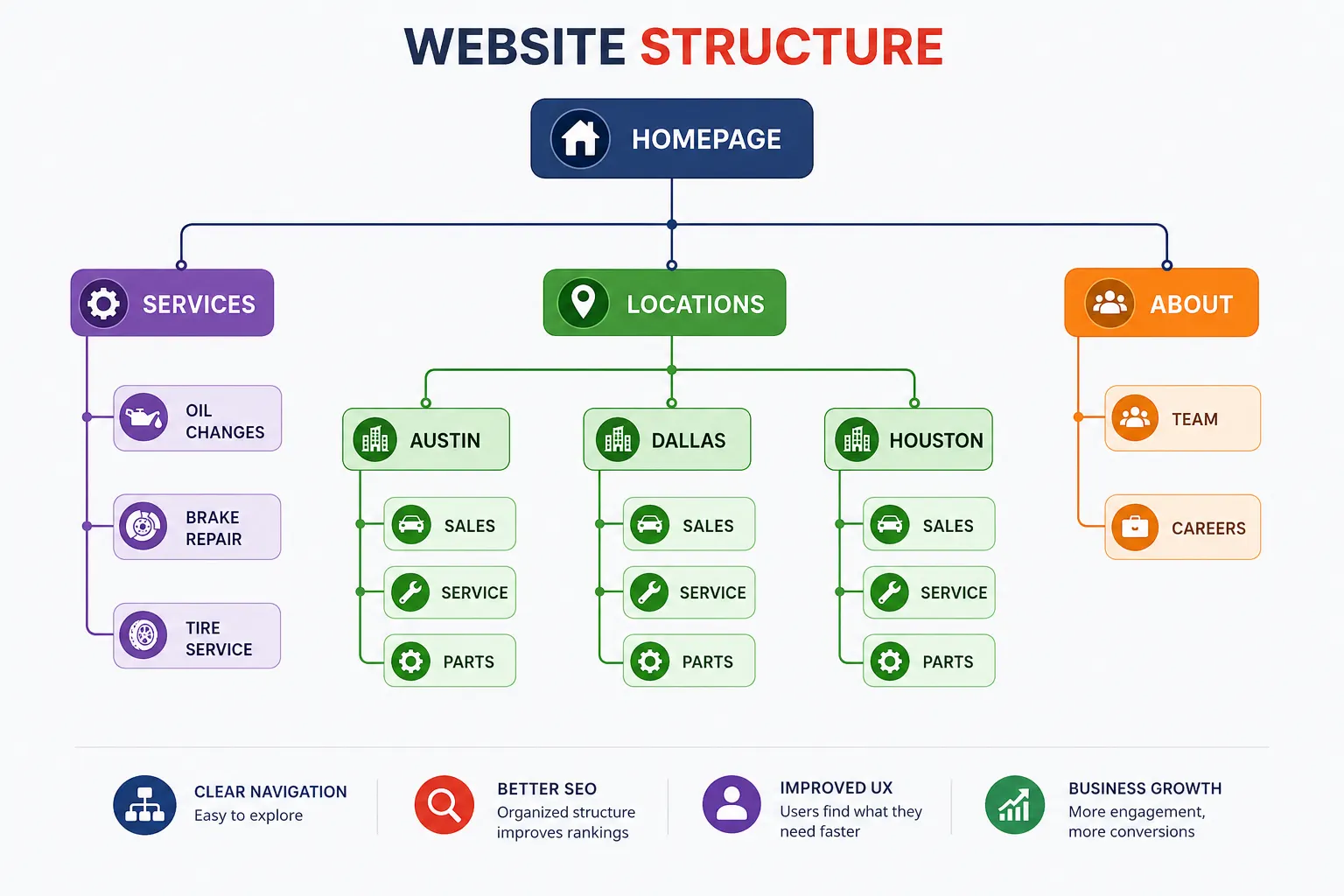
This structure serves multiple purposes. It distributes authority effectively. It creates clear topical relevance. It helps Google understand your exact business model. Deploy clean breadcrumb navigation so both users and search algorithms can easily find their way around. Crucial pages must never sit buried three clicks deep. This logical framework strengthens your entire dealership group SEO strategy.
Managing Your Crawl Budget Efficiently
Search engines allocate a strict crawl budget to every website. A massive dealer network wastes that precious budget if the backend is bloated. Manage it efficiently to ensure your most profitable pages get indexed fast. Make sure Google is not wasting time on:
- Duplicate URLs: Fix these immediately with proper canonical tags.
- Thin content pages: Merge them or rewrite them with real substance.
- Paginated archives: Use proper indexing rules to hide useless archive pages.
- Sorting parameters: Block inventory filters from search crawlers entirely.
Organizing Sitemaps for Multiple Branches
Do not dump every URL into one enormous, unstructured XML file. Segment your sitemaps logically by specific locations and service types. This structured organization makes it far easier to spot indexing errors at a glance. You avoid hunting through hundreds of links just to fix a single automotive location pages SEO error.
Testing Core Web Vitals on Templates
Most branch pages share a core design template. A single performance lag in that code replicates across every single location instantly. Test your templates thoroughly before rolling them out globally. One slow-loading image multiplied by fifty locations creates a massive SEO failure for automotive chains.
Optimizing Mobile Speed for Automotive Local Search
A massive share of local automotive searches happen on a smartphone. Drivers are rarely sitting at a desktop when car trouble hits.
To capture these urgent leads, you must adapt to how users actually search:
- The real-world scenario: Customers are frequently searching while standing in a parking lot with a dead battery or waiting on the shoulder of a highway.
- The testing protocol: Test your branch pages on actual 4G or 5G cellular connections. Do not rely on a fast office wifi network to gauge your page speed.
- The revenue impact: Slow load times cost you the exact buyers who need your help immediately. They will just hit the back button and call the next shop on the list.
Fast, responsive mobile design forms the absolute backbone of dealership “near me” optimization.
Deploying Canonical Tags Correctly
Location pages often share similar layouts and overlapping service descriptions. Canonical tags help search engines understand that each page stands completely on its own. Get this technical step wrong, and search algorithms might consolidate your ranking signals onto the wrong page. They might even ignore an entire branch completely.
Common Mistakes in Automotive Multi-Location SEO (And How to Fix Them)
A handful of critical errors show up constantly across growing dealer networks. These missteps drag down local map rankings and cost branches serious foot traffic. The good news is they are entirely fixable. Here is how specialized automotive SEO agencies like Marqade identify and solve these exact problems.
Publishing Cloned Location Pages
The Mistake: A marketing team takes one template, swaps the city name, and publishes it fifty times. This is the most common trap in automotive SEO for multi-location businesses.
| The Fix: Stop relying on duplicate content. We build unique, localized landing pages for every specific branch. We highlight real staff members, precise service lists, and neighborhood details to ensure each lot ranks on its own. |
Ignoring Keyword Cannibalization
The Mistake: Two nearby branches compete for the exact same search terms. Neither page wins cleanly. Both lots drag each other down in the search results.
| The Fix: Build a strict keyword matrix. We map out specific urban and suburban territories for every physical address. We force geographical differentiation so your branches conquer the market instead of fighting each other. |
Neglecting Local Review Profiles
The Mistake: Corporate focuses all attention on the flagship store. Smaller branches sit with a few reviews from three years ago. They look abandoned to nearby buyers.
| The Fix: Implement location-level review generation. We help automotive brands build automated systems that drive fresh reviews directly to the specific garage where the customer received service. |
Leaving Messy Digital Footprints
The Mistake: Dealer groups growing through acquisition often inherit a digital mess. Old business names, outdated phone numbers, and rebranded listings linger online and confuse search engines.
| The Fix: Run a comprehensive data cleanup. Our team at Marqade scrubs bad NAP data across the web. We lock in your correct information across hundreds of directories to restore trust and boost your dealership “near me” optimization. |
Deploying a One-Size-Fits-All Content Strategy
The Mistake: Publishing the exact same service descriptions and messaging across every location. A dense urban core faces different competition and customer needs than a small suburban town twenty minutes away.
| The Fix: Create regional content variations. We tailor your messaging to address the exact climate, driving conditions, and market density of every specific lot. |
Flying Blind Without Local Tracking
The Mistake: Corporate executives see overall website traffic but have no idea which specific locations generate phone calls or which ones sit stagnant.
| The Fix: Deploy granular tracking. We set up unique call tracking and localized analytics for every physical address. You see exactly which branches deliver a strong return on your local SEO for car dealerships. |
Sound familiar? If your automotive group struggles with even two of these issues, massive revenue is slipping through the cracks. Partnering with us at Marqade turns these technical liabilities into a highly profitable dealership group SEO strategy.
Here is the complete, refined section using your new heading and the improved formatting:
How to Measure SEO ROI Across Multiple Dealership Lots
Measuring returns across dozens of markets gets complex fast. But tracking exact revenue data forms the foundation of automotive SEO for multi-location businesses. Traffic numbers mean nothing if they do not translate into parked cars in the service bay.
KPIs Per Location vs. Aggregate Traffic
Looking only at total website traffic hides severe problems. An automotive group might see healthy overall numbers while three specific lots remain completely invisible online. You need both viewpoints. The aggregate view tracks corporate health. The per-location view identifies exactly which branches are winning and losing.
| Metric Focus | What to Track | Why It Matters |
| Per-Branch Data | Local sessions, GBP map actions, specific phone calls, branch revenue | Pinpoints exactly which lots need immediate SEO help. |
| Aggregate Data | Total organic traffic, combined bookings, overall keyword footprint | Shows the big picture health of your dealership group SEO strategy. |
The Technical Tracking Setup
To capture the full picture, your backend tracking must be flawless. Gut feelings do not drive revenue. Hard data does.
- Google Analytics 4: Set up separate views or use location-specific UTM parameters to track user behavior per lot.
- Google Search Console: Monitor impressions and clicks for specific URL paths to measure automotive location pages SEO performance.
- GBP Insights: Track map views, direction requests, and direct actions for every physical address.
- Call Tracking: Assign unique dynamic numbers to each garage. Track exactly which organic search drove the phone call.
- CRM Integration: Attribute vehicle sales and completed service tickets directly back to the originating local page.
Setting Realistic Timelines for Growth
Local search takes time to build momentum. Expecting overnight results leads to frustration. Here is a realistic timeline for executing successful local SEO for car dealerships:
- Months 1 to 3 (Setup): Run technical audits, fix backend errors, build unique branch pages, and deploy precise tracking software.
- Months 4 to 6 (Foundation): Publish regional content, clean up messy citation data, and optimize GBP listings. Early local traffic begins to appear.
- Months 7 to 12 (Authority): Secure neighborhood backlinks, manage review generation consistently, and watch map rankings climb.
- Month 12 and Beyond (Compounding ROI): Establish a firm presence in most markets. Enjoy sustained lead volume through secure dealership “near me” optimization.
Patience matters. Abandoning a campaign after three months because it feels slow means quitting right before the real momentum builds. A long-term approach yields substantial rewards.
Scale Your Automotive Business With Effective Multi-Location Local SEO
Do You Need an Expert Agency to Fix Your Multi-Location SEO?
Most dealership marketing teams are built to drive showroom traffic, not to untangle the technical web of enterprise search. When internal staff tries to juggle daily promotions alongside dozens of localized websites, corners inevitably get cut. This lack of bandwidth leads to duplicate content, keyword cannibalization between nearby branches, and smaller lots sitting completely neglected. Multi-location search demands dedicated daily focus to manage complex site architecture, build regional backlinks, and optimize dozens of Google Business Profiles simultaneously.
This is why growing dealer groups partner with Marqade to execute their automotive SEO for multi-location businesses. We bring the enterprise-level workflows required to prevent territorial overlap, clean up messy digital footprints, and track organic ROI down to the individual branch. Instead of relying on generalists guessing at local SEO for car dealerships, our team ensures every single location actually dominates its specific market. We handle the technical heavy lifting so your team can focus entirely on selling cars.
Conclusion
Growing a regional automotive brand is never about building one massive website and hoping it blankets every city you operate in. True automotive SEO for multi-location businesses requires treating each physical branch like its own standalone company. Each lot needs its own hyper-local content, independent review strategy, and precise technical tracking.
Skip this, and you end up with one flagship store carrying the entire company’s search visibility while the rest sit invisible. Execute a solid dealership group SEO strategy, and every single location transforms into an independent revenue engine.
The tactics outlined here are not quick fixes. Securing dealership “near me” optimization across dozens of markets takes serious effort. But dealership groups that commit to the grind build an asset competitors cannot easily replicate: complete market dominance in every single zip code they serve.
Ready to uncover how your branches actually perform online? Request a free multi-location SEO audit from Marqade today and see exactly where your biggest revenue opportunities are hiding.
FAQs (Frequently Asked Questions)
A single shop focuses on one localized footprint. Automotive SEO for multi-location businesses requires managing dozens of search signals simultaneously, preventing branches from cannibalizing each other, and scaling technical architecture without relying on duplicate content.
Build a strict keyword matrix. Write completely unique content for every branch, target specific long-tail neighborhood variations, and use precise internal linking to guide search engines to the correct local page.
Yes. Every physical garage requires a dedicated GBP listing with accurate hours, services, and local phone numbers. Combining lots or creating fake listings destroys your local SEO for car dealerships and risks immediate Google penalties.
Expect three to six months for initial movement at established stores. Newer lots require six to twelve months to build real local authority. Scaling a dealership group SEO strategy takes time simply because there is massive digital ground to cover.
The most profitable approach is a hybrid model. Corporate should handle the technical backend, site architecture, and overarching domain authority. Individual branches must focus heavily on local review generation and community partnerships.
Absolutely, but it requires dedicated focus. You cannot rely on corporate authority alone. Newer branches need aggressive citation building, targeted review generation, and unique automotive location pages SEO to close the gap quickly.
Relying on cloned content. Duplicating a location page template and merely swapping the city name is the fastest way to fail. Search algorithms filter out thin, repetitive pages regardless of how strong your main corporate domain is.
Get Your Free SEO Plan






 English
  Spanish
  French
  Dutch
Dutch