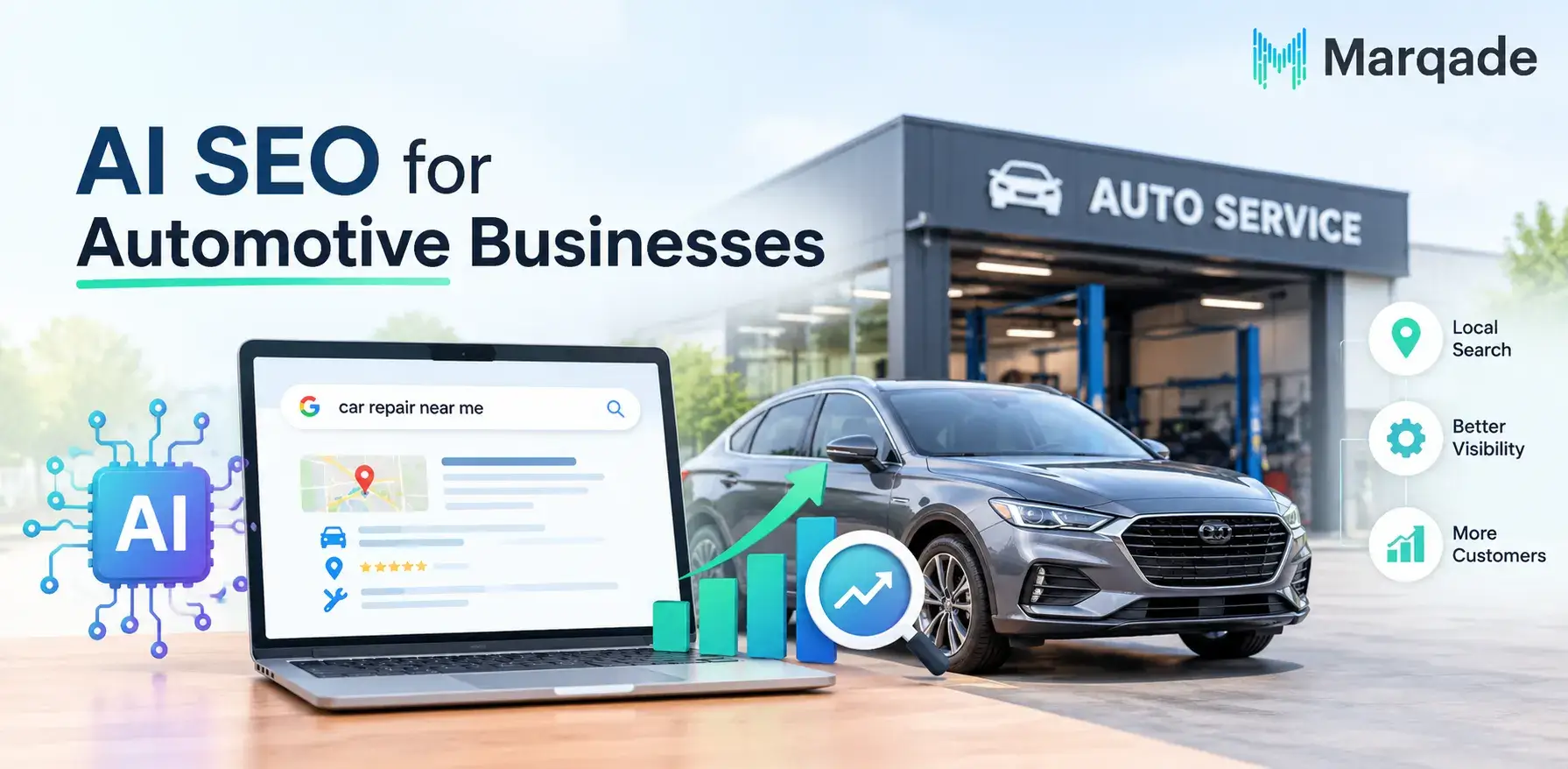
AI SEO for Automotive Businesses: Rank Higher in Local Search
Get a quick blog summary with:


People shopping for cars and booking service appointments still use traditional search, but they are also asking more conversational questions through tools such as ChatGPT, Gemini, and other AI-powered search experiences. These tools can surface direct answers, comparisons, and local recommendations without requiring shoppers to work through multiple searches.
For dealerships, that creates a new visibility layer—but it does not replace the fundamentals of SEO. Google says its AI search experiences still rely on the same core principles: helpful, original content and strong technical SEO, while local visibility also depends on complete, accurate business information. Thus, it’s important to use effective Automotive SEO solutions that help search engines recognize your dealership, its offerings, and its local relevance.
This guide explains how to use AI SEO for automotive businesses to strengthen both traditional local search visibility and visibility in generative search experiences.
How AI Search Is Changing Automotive Buying
Remember how people used to look for a vehicle? A buyer sat down at a laptop and ran five separate Google searches over three days. They typed “used pickup trucks,” clicked three dealer sites, left, and came back later to search for “Ford dealer near me.” Finally, they searched for warranty details. That old sequence gave you multiple chances to grab their attention. If your inventory page missed the mark, your local map listing or your blog post might still catch them.
That search journey is changing. Many buyers now combine traditional Google searches, map results, review sites, video, and conversational AI before deciding which dealership to contact.
The Shift in Customer Behavior
Buyers now pack five steps into a single prompt. They open an app and ask: “Which dealers within twenty miles have used F-150s with under 50,000 miles, and who offers the best warranty on them?”
Depending on the platform and query, AI-powered search may combine information from websites, business listings, reviews, and other sources to generate a more contextual answer.
The main change is that one conversational prompt can combine several buyer questions into a single interaction. A dealership that provides clear, current information about inventory, services, location, pricing, and customer experience gives search systems more useful material to evaluate and shoppers more reasons to consider the business.
Why Page-One Rankings No Longer Guarantee Traffic?
Standard search results gave everyone room to breathe. Ranking in the fifth or sixth spot on Google still brought a steady stream of phone calls and form submissions. You did not need first place to keep your service bays full.
AI search experiences change how information is presented, but they do not make traditional SEO irrelevant. Google says its AI features build on existing Search systems, so strong crawlability, useful content, and clear business information remain important.
Look at a typical answer generated by ChatGPT or a Google AI summary. You will not find ten blue links stretching down the page. You will see two, maybe three dealerships mentioned by name. That tiny shortlist takes up the entire conversation.
When business details are incomplete or inconsistent, your dealership may be harder for search systems to match with a specific local query. That does not automatically remove a business from every AI answer, but accurate and complete information gives search engines and users a clearer picture of what the dealership offers.
Inconsistent data, outdated business listings, and thin service pages do not just hurt your traffic. They tell AI models that your business is risky to recommend, handing high-intent local buyers directly to the competition.
What Happens When AI Can’t Verify Your Data
When AI-powered search systems cannot find clear, consistent business information, they have less reliable evidence to work with. Search systems may use other trusted sources, show incomplete information, or favor a different business that better matches the query. The goal of AI SEO is not to “control” an AI answer, but to make your dealership easier to understand, verify, and recommend when it is a relevant result.
The AI Trust Problem
Conversational search tools can use information from multiple sources to understand a local business. Conflicting names, addresses, phone numbers, hours, or service information make that entity harder to interpret consistently. Google also says complete and accurate Business Profile information helps it match businesses with relevant local searches.
The Real-World Cost of Inaccurate Data
Think about a customer searching for a Toyota dealer near me open Sunday. If your Google Business Profile clearly states Sunday hours, that information gives search systems a stronger, more reliable signal about your availability. If your hours conflict across sources, your dealership may be less likely to match the query accurately. Accurate business data is therefore an important foundation for local visibility and customer trust.
How AI SEO Works: Connecting Traditional Search, AEO, and GEO
Automotive search standards evolved rapidly over the last two years. Traditional search optimization is not dying, but the target definitely moved.
Car shoppers do not stick to a single search box anymore. They watch videos, use map apps, read vehicle brochures, and ask AI tools questions before visiting a showroom. To capture these buyers, modern automotive AI SEO brings three connected layers together:
- Traditional SEO: Builds your technical foundation. You optimize website speed, clean up site code, and target local search phrases so Google Maps and search crawlers index your inventory. Without this base, automated systems cannot read your lot.
- Answer Engine Optimization (AEO): Formats specific business facts so machines extract them instantly. When a shopper asks, “What time does the service desk open Saturday?”, AEO provides the exact answer in your opening sentence. If you bury oil change pricing under paragraphs of promotional text, algorithms skip straight to a competitor.
- Generative Engine Optimization (GEO): Secures your place in AI summaries. Large language models do not invent inventory out of thin air; they scan authoritative sites, customer reviews, and local directories. GEO proves your business is credible across the entire web so AI tools cite your dealership by name.
Key AI Platforms Automotive Shoppers Use Locally
| AI Platform | What It Does for Car Buyers |
| Google Gemini and AI Overviews | Powers the direct summaries sitting at the very top of Google search results. |
| ChatGPT | Browse the live web to compare vehicle specs and pull local dealer inventory. |
| Perplexity AI | Acts as a strict answer engine that clearly cites its sources with clickable footnote links. |
| Microsoft Copilot | Integrates directly into Bing and Windows to serve up fast automotive facts and comparisons. |
| Claude | Processes massive amounts of data to give buyers deep, contextual comparisons between specific car models. |
How AI Processes Your Dealership’s Content
Search engines no longer depend on basic keyword matching. Modern platforms like Google AI Overviews, ChatGPT, and Perplexity use three main technologies to evaluate your dealership:
- Machine Learning (ML): This tracks whether your dealership publishes accurate information over time. Updating your website once a year hurts your visibility because algorithms prefer consistent, active local sources.
- Natural Language Processing (NLP): This helps AI understand conversational questions, like someone asking for a reliable used truck to tow a boat. Instead of hunting for exact keywords, AI looks for content that answers real customer questions directly.
- Generative AI (GenAI): This gathers facts from multiple websites to build one summary. Clear headings, bullet points, and structured data help GenAI pull your inventory and service details accurately.
Comparing Traditional SEO, AEO, and GEO
| Strategy | Primary Target | Main Goal | What Gets Rewarded | Risk if Ignored |
| Traditional SEO | Search engines, map apps | Earn a direct click | Site speed, local keywords, clean code | Losing everyday map traffic |
| AEO | Featured snippets, voice search | Provide instant facts | Clear headings, upfront answers, FAQ formatting | Missing quick-answer boxes |
| GEO | ChatGPT, Gemini, Perplexity | Earn direct recommendations | Total web consistency, verified reviews, structured data | Reduced visibility in relevant AI answers |
What Actually Improves AI Search Visibility?
There is no single AI-search trick that guarantees a dealership will be cited or recommended. Google says the same core SEO principles that help pages perform in Search also apply to its AI experiences: create unique, useful content, make pages accessible to search engines, and give users a satisfying experience.
For automotive businesses, prioritize these fundamentals:
- Accurate and complete business information across your website and local listings.
- Strong technical SEO, crawlability, mobile usability, and indexable inventory pages.
- Original content that demonstrates real automotive and local expertise.
- Clear answers to high-intent buyer and service questions.
- Genuine reviews and a strong local reputation.
- Relevant authority signals from reputable automotive and local sources.
AEO and GEO can be useful frameworks for planning content for answer-based and generative interfaces, but they should complement—not replace—traditional SEO.
How to Use AI SEO to Rank Higher in Local Search
You explored how conversational search engines read your dealership data and why traditional rankings no longer guarantee website traffic. Now comes the execution phase. Follow these ten practical steps to improve AI SEO for automotive businesses, clean up your local data, structure your content, and earn reliable recommendations in local search results.
1) Optimize Your Google Business Profile for AI
Your Google Business Profile is an important part of your local search presence. Strong Automotive Local SEO helps keep your dealership’s business details, services, and location signals clear and consistent across the web. Google says complete and accurate Business Profile information helps businesses appear for relevant local searches.
For example, if a customer asks ChatGPT for a “Toyota dealer nearby open on Sunday” and your profile lacks the following, the algorithm will bypass your store and recommend a competitor instead.
Categories
Choose the most accurate categories for your dealership. Avoid vague or generalized options that force automated systems to guess your specialty.
Services
List every single service you offer. This granular data helps AI models match your showroom and service bays directly to specific shopper needs.
Hours
Keep your hours updated for all departments. AI search tools cross-reference operating schedules constantly to verify real-time availability.
Photos
Upload real, high-quality photos of your physical dealership, active inventory, and team members. Authentic visual data establishes real-world entity trust.
Posts
Publish weekly updates to show your business stays active and engaged. Stale profiles tell search crawlers that your local presence might be neglected.
2) Ensure NAP Consistency Across the Web
AI systems evaluate signals from across the entire web to understand a business entity. When a dealership name, street address, or phone number varies between the official website, Google Business Profile, Yelp, and industry directories, AI receives conflicting signals and loses confidence in the listing.
What to do:
- Audit all business listings on major directories.
- Correct any discrepancies in name, address, or phone number.
- Use the exact same formatting everywhere.
Consistent business data builds the trust signals that both traditional search engines and conversational AI rely on to verify physical locations.
3) Make Schema Markup a Priority
Schema markup is structured data added to a website’s backend that labels content so search engines can understand its context. Think of it like a name tag for information. Instead of guessing what something means, AI gets a clear signal.
For dealerships, proper schema can identify:
- Dealership name, physical location, and operating hours
- Inventory details like final price, mileage, and vehicle condition
- Customer reviews and verified star ratings
- Specific service offerings and maintenance specials
Structured data can help search engines understand the content and context of a page when the markup accurately matches the visible content. It should support—not replace—clear page content and strong technical SEO.
Implementing technical code across large inventory catalogs can get complex. When backend errors slow things down, many businesses prefer to get helping hands from specialized automotive SEO services to ensure clean schema deployment and keep technical foundations locked down for local AI search.
4) Use an Answer-First Content Approach
Conversational search works best when important information is easy for both people and search systems to identify. Lead with a direct answer, then provide supporting detail, examples, qualifications, and useful context. This approach improves readability without assuming that an AI system will always extract the first sentence of a page.
Effective content marketing flips traditional writing on its head by leading with the bottom line. For instance, instead of starting a model review with dealership history, answer the query with a direct confirmation:
Yes, the Toyota RAV4 performs very well in deep snow thanks to its electronic all-wheel-drive system and 8.1 inches of ground clearance…”
Only after giving that immediate answer should the content expand into trim levels, fuel economy, and cargo space. When text answers buyer questions right out of the gate, AI engines extract, summarise, and feature the business in top results.
What to do:
- Create dedicated pages that answer real shopper questions in the first sentence.
- Structure articles using clear H2 and H3 headings so scrapers can easily parse sub-topics.
- Write in plain, conversational language that real buyers use every single day.
Example: Turn a Generic Content Into an AI-Ready ResourceA weak dealership website might simply list “brake repair, oil changes, tire service, and inspections.” A stronger page answers the questions a real customer is likely to ask: How long does brake service take? Which brake components do you replace? Do you offer same-day appointments? What symptoms mean the vehicle should be inspected immediately? Do you service the makes and models we sell? Give the direct answer first, then add pricing guidance where appropriate, service details, qualifications, appointment information, and location-specific context. This makes the content more useful to customers and gives search systems clearer information to interpret. |
5) Upgrade Your Service Pages
Many dealerships use simple four-page websites that only show home, about, services, and contact sections. These short pages do not give enough information, so search engines ignore them.
Top dealerships create separate pages for every service they offer. A general service page is too broad, but a specific page for brake repair targets a customer who is ready to buy.
For example, if a customer is searching for brake pad replacement, they are not interested in a general maintenance list. They want to read about how long the job takes, what parts are used, and how much it costs. Writing these pages from a mechanic’s point of view gives customers and search engines the exact details they need.
6) Build a Review Profile That Wins AI Search
Reviews are a massive deal when it comes to AI visibility. Whenever someone asks an assistant to find a local Ford dealer, the tool scans the web to see what people are saying, and reviews are the loudest signal it finds. AI looks at your entire dealership as one single business, so if your reviews are thin or old, you get left out of the conversation entirely. Getting this right is a core part of AI SEO for Automotive Businesses.
Want to get the algorithm on your side? Here is how to step up your review game:
- Set volume targets: Set a realistic review-growth target by comparing your dealership with direct competitors in the same market. Focus on steady, genuine review generation rather than chasing a universal number.
- Focus on recency: Keep an eye on how often new reviews come in. Recent, genuine reviews can add fresh evidence about the customer experience, while older reviews still contribute to the overall reputation of the business. Aim for consistent review activity instead of relying on a one-time campaign.
- Encourage detail: Skip the scripts and just ask customers for honest details. When they mention a specific staff member or how the financing went, it builds instant trust with both shoppers and AI.
- Respond quickly: Try to answer every review within 48 hours. Keep it genuine for the positive ones and helpful for the negative ones.
- Balance service and sales: Do not forget your service department. Running a dedicated review program there helps both sides of your business build a stronger, more balanced reputation.
7) Target Local and High-Intent Keywords for AI Search
Keywords are still important, but the way you choose and use them has changed. In the age of AI search, you need to think less about short keyword fragments and more about complete, conversational questions.
- Why Traditional Keywords Fall Short
Traditional SEO focused on short terms like “used cars” or “oil change.” These broad terms bring in traffic, but lack buying intent. AI search tools are designed to understand specific intent. When a shopper asks, “Where can I sell my used truck for cash in Dallas today?”, the AI looks for a dealership that explicitly answers that exact need.
- Move from Keywords to Complete Questions
Build your content around full questions that AI tools can lift directly into their summaries.
|
Traditional SEO Keyword |
AI-Ready Content Question |
| “brake repair [city]” | “How much does brake repair cost in [city]?” |
| “oil change [city]” | “Where can I get a same-day oil change near [neighborhood]?” |
| “used trucks [city]” | “Which nearby dealerships have used Ford trucks under $30,000?” |
-
Use Local Modifiers That Matter
Shoppers use AI to find nearby solutions. Match their local language by using specific neighborhood names, major landmarks, community terms, and local zip codes.
-
Incorporate High-Intent Action Phrases
Capture ready-to-buy shoppers by including action-driven phrases in your content, such as same-day, get a quote, schedule an appointment, and immediate availability.
8) Target Bing and Alternative AI Search Engines
Most dealerships still focus heavily on Google, but AI-powered search products can use multiple search and information sources. ChatGPT Search, for example, can search the web and return linked sources, and OpenAI says site owners should allow OAI-Searchbot to crawl their content if they want to be eligible for inclusion.
For dealerships, the practical takeaway is to maintain accurate information across Google, Bing, and other reputable directories rather than relying on a single ecosystem.
Maintaining accurate information across major search ecosystems reduces the risk of inconsistent business data when customers discover your dealership through different platforms.
What to do:
- Claim and verify your Bing Places listing with accurate operational hours and address data.
- Submit your website sitemap to Bing Webmaster Tools to ensure fast crawling.
- Audit your visibility across secondary search directories that feed data into conversational models.
9) Make Sure Your Site Is Technically Sound
AI search tools need a strong foundation to read websites. If pages load slowly, have broken links, or are difficult for bots to navigate, AI systems simply skip local dealerships and send customers elsewhere. Proper technical SEO is a key pillar of successful AI SEO for Automotive Businesses and helps optimize an automotive website for AI search.
Key technical priorities:
- Page loading speed: Keep important dealership pages fast and usable on mobile. Performance is part of a strong technical foundation, but avoid treating one speed metric as a guaranteed ranking factor. Focus on the overall page experience, crawlability, and usability of inventory and service pages.
- HTTPS security: Secure websites build instant trust with both buyers and search engines.
- Mobile-friendly design: Since most customers using cars are on mobile, it is important for the website pages to be mobile-friendly.
- Site architecture: Search bots should be able to crawl and index all inventory pages successfully.
For dealerships, improving mobile performance, crawlability, and inventory architecture can remove technical friction for both traditional search engines and AI-powered search experiences. Strong automotive website optimization also makes the site easier for customers to use.
10) Build Local Authority and Earn Trust
The artificial intelligence tools analyze the trustworthiness signals that originate from all over the Web, which means that the more reputable sources speak about the dealer, the greater the probability of an AI tool’s recommendation. Although search engines do not use links in conversational citations, quality backlinks increase the website’s visibility with proper SEO link building. The dealerships may increase their authority by collaborating with the OEMs, appearing in local news related to the market situation and writing guest posts on automotive blogs.
Earning trust also requires deep community involvement and proper AI SEO for Automotive Businesses. Local businesses should secure citations from the chamber of commerce, join automotive association directories, and sponsor local events. These signals are particularly valuable for local AI SEO strategies for automotive businesses.
For example, getting featured on local directory blogs or community roundup posts, such as a “Best Auto Repair Shops” list, creates natural links that prove local relevance. When trusted third-party websites frequently recommend a dealership, modern AI systems gain the confidence needed to serve that brand directly to local shoppers. This can also help businesses improve automotive search rankings over time.
How to Track Your Local AI Search Visibility
While traditional tracking systems can only measure simple website actions like clicks and keyword rankings, today, with instantaneous answers through conversational AI tools like ChatGPT or Google AI Overview, those reports often include little. If you’re unsure how to monitor your visibility in AI searches, here is a brief overview of the metrics you should track and why. This tracking process is becoming increasingly important for AI SEO for automotive dealerships.
1. What Metrics Actually Matter?
Instead of just counting website visitors, you need to track how AI systems talk about your business:
- AI Citation Frequency: How often an AI tool mentions your dealership name when a customer asks for a recommendation.
- Competitor Benchmarking: Checking if the AI recommends your rival dealership down the street instead of you.
- Brand Sentiment: Whether the AI describes your business with positive details or points out bad customer feedback.
2. How to Set Up Monitoring Systems
You cannot check every AI tool manually every single day, so you need specialized software.
- Use AI Tracking Platforms: Software like Semrush AI Visibility, Peec AI, or Omnia can automatically test hundreds of local buyer questions across platforms like ChatGPT and Google. These tools show you a clear dashboard of where your dealership wins and where you disappear.
- Watch for Schema and Technical Errors: Set up automated alerts to catch broken website code immediately, ensuring search crawlers can access your inventory and operating information.
Use Google Search Console to Measure Generative Search Visibility
Google launched Search Generative AI performance reports in June 2026 for a subset of websites. The new reports provide dedicated visibility into impressions from generative AI features such as AI Overviews and AI Mode, while continuing to include this activity in the broader Search performance reporting.
When the report is available for your site, use it alongside traditional Search Console data. Compare pages, countries, devices, and trends over time, then connect those changes to improvements you make to content, technical SEO, local information, and service or inventory pages.
Regular monitoring can also show you how to increase automotive website visibility with AI by identifying the platforms, questions, and competitors where your dealership is currently underperforming.
3. Tracking Lead Quality from AI Traffic
Visitors arriving from conversational AI act differently than regular web traffic. They are usually ready to buy. To measure their value, look at your website analytics and track:
- Vehicle Detail Page (VDP) Views: See how many people click through from an AI citation directly to your car listings.
- Form Fills vs. Traditional Traffic: Compare whether leads coming from AI tools buy cars or book service appointments faster than standard web visitors.
Setting up these advanced tracking systems and analyzing AI data can feel overwhelming if you are managing a busy dealership lot. Getting professional help from a specialized automotive SEO agency can make a massive difference. Experts can properly configure your tracking dashboards, monitor competitor movements, and ensure your inventory data feeds smoothly into every major conversational platform. When dealerships combine the right tracking tools with expert guidance, they can fix weak spots quickly and capture more buyers before those customers ever set foot on a physical lot.
How to Run a Data Audit for AI SEO for Automotive Businesses
Local data can quietly go stale because of a new phone system, a schedule change, or a rebrand, and AI tools notice inconsistencies faster than most business owners expect. Because a proper SEO audit is not a one-time project, use the checklist below as a starting point for recurring reviews:
| Audit Action Area | What to Verify and Fix | Why It Matters for AI Search |
| NAP Consistency | Confirm Name, Address, and Phone number match across your website, Google Business Profile, and all third-party directories. | AI systems cross-reference multiple sources to confirm your business details before recommending you. |
| Department Hours | Verify separate, accurate hours for sales, service, and parts departments. | Shoppers often ask conversational tools for mechanics open on specific days or evenings. |
| Directory Profiles | Review and correct listings on Yelp, Yellow Pages, and automotive-specific directories. | Conversational models pull background context and local trust signals from these platforms. |
| Service Offerings | Ensure your website clearly lists all services offered, department by department. | AI search engines need explicit text to match specific repair or vehicle-buying prompts to your lot. |
| Schema Markup | Add or update structured data for business info, services, and FAQs. | Clean structured data can help search engines interpret business and page information more consistently. |
| Service Areas | Check that your location pages reflect your actual coverage area and local neighborhoods. | Local intent queries rely on precise geographic boundaries to filter out irrelevant options. |
| Recurring Review | Set a schedule for a recurring quarterly review to catch data drift. | Prevents outdated phone numbers or old addresses from confusing AI bots and turning away buyers. |
The Human Factor to Improve AI SEO for Automotive Businesses
AI systems can process large amounts of information quickly, but they cannot replace the value of genuine local expertise and first-hand dealership experience. Original knowledge from technicians, service advisors, sales staff, and finance teams gives a website useful information that generic competitors may not have. Successful AI-powered automotive SEO bridges that gap, combining automated technology with the genuine showroom experience found in customer reviews and original team content.
Showcase Your Team’s Expertise
The dealerships winning online right now feature websites written by people who know cars inside and out. Your service advisors remember past repairs, your technicians explain complex fixes clearly, and your finance managers demystify rates.
To turn this into a search advantage, integrate these practical steps into your content strategy:
- Add detailed staff bios: Include real credentials, certifications, and years of experience on your department pages.
- Encourage authentic reviews: Focus on getting detailed customer feedback rather than generic star ratings.
- Involve your technicians: Let service advisors contribute first-hand answers to your website’s FAQ sections.
- Highlight hyper-local knowledge: Discuss specific neighborhood driving conditions, regional maintenance needs, and local routes.
Generic “why choose us” pages can be rewritten by a competitor in an afternoon, but a detailed technical breakdown from a technician with fifteen years of experience cannot. Weaving this first-hand knowledge into your website creates the exact trust signals both AI models and real car buyers rely on to make their final choice.
Common Mistakes to Avoid in AI SEO for Automotive Businesses
As dealerships figure out how to show up in conversational search, it is easy to slip into habits that quietly hurt your visibility. Steering clear of these common pitfalls keeps your store looking trustworthy to both search bots and local car buyers:
- Leaving your business info messy: Letting old phone numbers, mismatched addresses, or outdated names sit on third-party directories confuses AI tools and ruins your local trust.
- Publishing robotic, AI-written text: Pumping out generic blog posts written entirely by AI makes your dealership blend into the background instead of sounding like a real team of car experts.
- Skipping structured code: Forgetting to add clean backend code forces AI engines to guess your service hours, parts department details, and location specifics.
- Treating local data as a one-and-done chore: Fixing your Google Business Profile once and forgetting about it leaves you wide open to data drift the moment your phone system or operating hours change.
- Chasing empty traffic numbers: Focusing only on how many total visitors land on your site while ignoring actual buying signals, like shoppers clicking through to vehicle details or service forms, keeps you in the dark on what is actually working.
These mistakes can limit automotive AI search optimization even when a dealership has strong traditional SEO performance.
Start Your Local AI SEO Journey Today
Artificial intelligence search is growing rapidly, but traditional search still drives the vast majority of leads for dealerships today. When Wikimotive mapped LLM traffic against organic search traffic across 150 dealers, ChatGPT emerged as the clear leader among AI tools. However, compared to the broader organic search opportunity, conversational traffic currently accounts for a tiny fraction of total volume.
The shift toward conversational search is happening, but everyday consumer habits have not fully caught up to the technology yet. That gap creates a crucial planning window for dealerships to establish authority before the market shifts entirely.
Balancing traditional visibility with next-generation conversational optimization requires specialized strategy and technical execution. Implementing effective AI SEO for Automotive Businesses helps strengthen your digital footprint across both standard search engines and conversational platforms. If you want to future-proof your inventory pages and capture high-intent local buyers, partnering with an experienced automotive SEO agency provides the exact technical framework and schema management needed to stay ahead. Taking action today secures your market share now while building the long-term trust modern algorithms demand.
Conclusion
When local car buyers use traditional search or AI-powered search experiences, the goal is the same: make your dealership an accurate, useful, and trustworthy result for the right query. That starts with strong local SEO, complete business information, technically accessible pages, original automotive expertise, and a reputation supported by genuine customer feedback.
AI SEO for Automotive Businesses brings these foundations together for a search environment where buyers may discover, compare, and evaluate dealerships through both conventional results and conversational answers.
Want to secure a top position in conversational search? Contact Marqade for a free consultation and build a custom AI SEO roadmap for your dealership today.
FAQs (Frequently Asked Questions)
AI SEO for automotive businesses is the practice of applying strong SEO, local search, technical, content, and reputation strategies so a dealership is easier to discover and understand in both traditional search and AI-powered search experiences.
No, traditional search still drives the vast majority of dealership leads. AI search grows fast, but consumer habits take time to change. A smart strategy combines standard organic optimization with conversational search tactics.
AI-powered search systems can use multiple sources to understand a dealership, including its website, local business information, reviews, and other reputable web sources. Consistent, useful information gives those systems clearer evidence about the business and its relevance to the query.
When your dealership hours or phone numbers conflict across directories, AI tools view your business as unreliable and skip your lot in favor of competitors with clean data.
Most dealerships use identical manufacturer copy, which makes them blend together. You stand out by publishing original dealership knowledge that competitors cannot easily reproduce, such as detailed staff bios, technician answers, local driving guides, ownership tips, service explanations, and authentic customer experiences.
Structured data acts as backend code for search engines. It helps algorithms read your inventory details, pricing, and service department hours without guessing.
Start by auditing your Google Business Profile, website contact pages, and major business directories. Make sure your business name, address, and phone number match across every platform. Consistent data is essential for both traditional local SEO and AI search visibility for auto businesses.
Relying entirely on AI-generated text produces robotic content. Search engines and car buyers prefer authentic expertise from real service advisors, technicians, and finance managers.
Fixing citations and indexing structured data takes time. Most dealerships see measurable improvements in organic traffic and visibility within a few months. The exact timeline depends on competition, your current website condition, local authority, and the scope of your automotive SEO strategy.
Look for an experienced partner specializing in the automotive sector. A qualified team handles inventory feeds, schema code, and localized content strategies to secure your market share using AI SEO for Automotive Businesses.

Ritu is an SEO content writer and press release specialist with experience in digital marketing and Reddit community research. She leverages audience insights, trend analysis, and strategic storytelling to create authoritative content that enhances brand visibility, drives engagement, and delivers value to readers across diverse industries.
Get Your Free SEO Plan