How to Improve Your Brand’s AI Reputation
Get a quick blog summary with:


- AI reputation shapes whether brands appear in ChatGPT, Gemini, and Google AI Overviews.
- Audit AI platforms using targeted prompts to spot outdated or missing brand information.
- Six core strategies build stronger visibility: listings, reviews, content, mentions, schema, and alignment.
- AI reputation needs ongoing monitoring, not a single audit or one-time fix.
Brand discovery has changed: users no longer type queries into a search bar and scroll through blue links. Instead, they ask AI tools questions: “What’s the best solution?” or “Tell me about this company.” The answers arrive in seconds and carry weight. In fact, recent research by Search Engine Land (2025) reveals that 37% of consumers start their online search with AI platforms. This shift changes what it means to be visible online.
A new frontier for visibility has opened, shaped by AI reputation management. What results does AI deliver when someone asks about a brand? That answer comes from reviews, articles, and third-party mentions pulled into one composite profile. Most brands have no idea what that profile says. This guide shows how to improve your brand visibility in AI search, covering audit, optimization, and the trust signals AI relies on.
What Is AI Reputation Management?
AI reputation management is the practice of shaping what AI systems say about a brand when someone asks. Traditional reputation management focused on search rankings, star ratings, and website content control. AI reputation works differently: it draws from data scattered across reviews, forums, news articles, and third-party mentions, then synthesizes it into a single answer. No single brand controls this answer.
A restaurant might hold five-star reviews on Google, yet forum complaints about slow service can surface with equal weight. Consider the mechanism: large language models pull information from thousands of sources, weigh credibility, and generate a summary that reads as fact. This summary becomes the brand’s identity to anyone using AI search.
The same signals shape AI brand visibility, determining not only whether a business appears in an answer but also whether AI considers it relevant enough to mention for a specific need. That shift in identity control ties to search visibility: consistent, credible signals lead AI to recommend a brand instead of a competitor.
How Does AI Reputation Impact a Brand Image?
AI reputation cuts two ways. It builds visibility when a brand earns it and takes it away when it doesn’t. Some systems reward brands that publish credible content and respond to customer feedback with consistency. Others punish shortcuts: fake reviews, generic AI-written replies, thin content built for volume instead of value. The difference comes down to whether a brand manages AI reputation on purpose or leaves it to chance.
Why Zero-Click Search Raises the Stakes
Search results increasingly answer the question before a user ever clicks through. AI Mode searches end without a click 93% of the time, well above the roughly 60% zero-click rate across Google search overall. That shift changes what a ranking is actually worth.
| Metric | What Changes | What It Means for a Business |
| Zero-click rate (Google overall) | ~60% of searches end with no click | Most searches for a brand’s category may never reach any website at all |
| Zero-click rate (AI Mode) | 93% of searches end with no click | Ranking well no longer guarantees a visit, even at the top spot |
| Organic CTR with AI Overviews present | Drops 61%, from 1.76% to 0.61% | A page can rank in the same position and still see most of its traffic disappear |
| Paid CTR with AI Overviews present | Drops 68%, from 19.7% to 6.34% | Paid placement loses much of its usual return once an AI summary sits above it |
| Top organic position CTR | Drops 58% | Even the #1 result is no longer a reliable traffic source on its own |
Figures cited from Semrush, Seer Interactive (25.1M impressions analyzed), and Ahrefs research.
AI Overviews aren’t rare either. They now trigger on close to 30% of US desktop keywords, and up to 47% of all Google queries. That is why AI search visibility now matters alongside traditional rankings. AI-generated answers can shape how potential buyers first understand a business. For example, when someone is researching a product or service, an AI Overview may introduce them to brands before they visit any individual website. This is why AI Overviews matter for buyer research and why appearing accurately in these answers has become part of building a strong AI reputation. If AI presents a business with incomplete information, weak trust signals, or negative context, that information can influence how potential buyers perceive the brand during their research.
The Two Sides of AI Reputation
The Opportunity: Stronger Signals, Better Visibility
- Publish people-first content. Google’s search guidance draws a clear line here: AI-assisted content is fine when it’s original and free of thin, scaled automation. Original, experience-driven pages, the kind with named authors and clear citations, tend to win twice, with readers and with the AI systems summarizing them for someone who never visits the site.
- Treat reviews as an ongoing signal, not a one-time score. Consumers don’t trust a single number. A BrightLocal survey found that 40% check two or more review sites before choosing a business, and only 7% expect no response at all. That’s close to the real answer to how do Google reviews affect AI visibility: consistency and response rate carry as much weight as the star rating itself.
- Build a source of truth layer. False claims spread online, and AI systems can repeat them without checking. A policy hub or dated FAQ page fixes that, giving AI a citable, accurate reference that outranks an outdated complaint.
The goal is not simply to collect more AI signals. Stronger, more consistent signals improve AI visibility. This practice signals to AI systems that your brand has enough information to understand what it does and when to recommend it.
The Risk: Fake Signals, Real Consequences
- Fake reviews carry legal weight. In 2024, the FTC finalized a rule banning the sale or purchase of fake reviews, including AI-generated testimonials, and imposing civil penalties on violators. Liability doesn’t stop at a brand’s own team either; an agency or affiliate’s violation can land on the brand itself.
- Generic AI responses erode trust. Readers can tell when a reply is automated. That moment of distrust ties to whether negative reviews affect AI reputation: AI models weigh a brand’s response the same way they weigh the complaint itself.
- Restraint beats reaction. One retail brand, hit with a wave of one-star reviews after a supplier defect, resisted the urge to answer every complaint one by one. A single transparent policy update did more work than a hundred separate replies. The narrative held, and newer reviews referenced the resolution without being asked.
So, Is AI Reputation a Risk or an Opportunity for Your Brand?
This comes down to management, not chance. Brands that publish credible content, monitor reviews across platforms, and maintain a source of truth capture the opportunity side. Brands that ignore fake-review risk or lean on generic AI responses absorb the exposure side instead. In practical terms, the difference often appears in AI brand visibility: strong, trusted signals give a business more opportunities to appear in relevant AI-generated answers.
Build a Stronger AI Reputation for Your Brand
How Do AI Platforms Describe a Business?
Every AI platform builds its answer about a business from a different mix of sources. Results in Google AI Overviews depend on Business Profile data and local signals pulled from search. ChatGPT looks past a brand’s own website toward third-party mentions for corroboration. Gemini draws on Google’s Knowledge Graph and structured data. A business can hold a strong presence on one platform and remain nearly invisible on another because each platform trusts a different mix of signals.
The same principle applies across industries. For example, automotive businesses can face specific challenges when trying to appear in AI-generated search results. To address these challenges, businesses can use strategies such as AI SEO for automotive businesses to improve dealership information, vehicle and service content, location relevance, and answers to potential car buyers’ questions. These signals help AI platforms understand the business and decide when it is relevant enough to mention or recommend.
Let’s learn more about it:
| Platform | How It Behaves | Signals It Leans On |
| ChatGPT (OpenAI) | Builds detailed, conversational answers | Third-party mentions, structured data, review site content |
| Google AI Overviews | Pulls concise summaries straight from search results | Google Business Profile data, local pack signals, on-page authority |
| Gemini (Google) | Draws on multimodal, entity-based context | Knowledge Graph data, structured data, connected Google properties |
| Perplexity | Functions like a research assistant, citing sources inline | News coverage, academic sources, well-cited third-party content |
| Microsoft Copilot | Operates inside productivity tools and workflows | Business directory listings, LinkedIn presence, professional content |
| Claude (Anthropic) | Produces careful, nuanced responses | Clearly structured content, demonstrated expertise, sourced material |
A business built around Google’s tools, strong listings, active reviews, may still read as thin or generic to ChatGPT, which weighs third-party mentions over a brand’s own profile. Perplexity behaves closer to a research tool, favoring citations over marketing language. A reputation built to hold up across all these platforms, rather than the one a business happens to know best, separates a brand that earns AI-generated recommendations from one AI hardly acknowledges. The strongest brands build AI visibility that can support accurate recognition across several platforms at the same time.
How to Check AI Reputation of a Business
An AI reputation audit starts with a set of prompts run across platforms, read the way a stranger would. This is the fastest way to answer how do I monitor my brand’s AI reputation: test what AI already says before assuming it says anything at all.
Prompts to Run During an AI Reputation Audit
| Purpose | Prompt to Test | What It Reveals |
| Accuracy of offerings | “What products or services does [business name] provide?” | Whether AI has outdated or incomplete service details |
| Trust signals | “How reliable is [business name] based on available information?” | Whether AI associates the brand with credibility or uncertainty |
| Category ranking | “Which [service] providers stand out in [city]?” | Whether the business appears for high-intent local searches |
| Competitive standing | “What other companies compete with [business name]?” | Whether competitors surface instead, and why |
| Recommendation strength | “Should someone choose [business name] for [service]?” | Whether AI actively endorses the brand or stays neutral |
| Sentiment summary | “What has customer feedback been like for [business name]?” | Whether AI pulls recent, accurate sentiment or outdated complaints |
Run each prompt across ChatGPT, Gemini, and Google AI Overviews at minimum. A strong answer on one platform is not a guarantee of visibility everywhere else.
Let’s Take an Example
Suppose a company wants to check whether it appears when people search for an AI reputation management company USA. A search for “best AI reputation management company USA” can trigger a Google AI Overview that summarizes relevant companies and highlights businesses it considers useful for answering the query.
In this example, Marqade appears in the AI Overview alongside other companies in the AI reputation and online reputation management space.
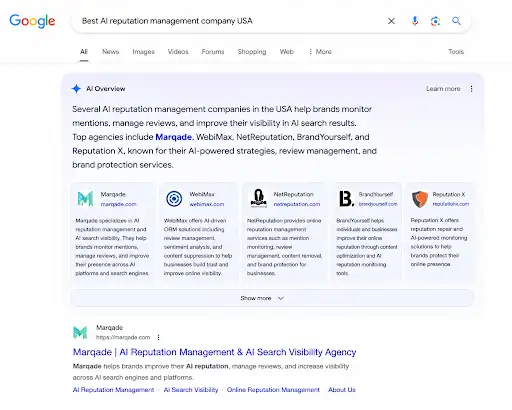
Finding the brand name is only the first step. The real audit starts with how AI presents the company once it appears. When Marqade shows up, the checklist looks like this:
- Is the company name mentioned without confusion?
- Is the business associated with the correct services?
- Does the description reflect what Marqade actually offers?
- Is the brand presented as a relevant option for the search query?
- Which competitors appear alongside the company?
- Do those competitors receive stronger descriptions in the same answer?
- Does the AI Overview include sources that support the brand mention?
This is where AI search visibility and AI reputation management start to overlap. A business can appear in an AI-generated answer and still hold weak AI brand visibility if the AI mentions the brand using outdated information, incorrect services, or positions competitors as stronger alternatives. A business can also earn strong reviews and a solid reputation while missing from the AI Overview, pointing to a visibility or authority gap. The goal of an AI reputation audit is to catch both problems, not just one.
How to Monitor AI Reputation Over Time
A single check shows what AI says today. Monitoring shows whether that answer holds up next month, next launch, or after new reviews come in.
Which Platforms to Monitor
Overlap in cited sources between platforms like ChatGPT and Perplexity tends to run low, which means monitoring one platform says little about the rest.
| Platform | What to Monitor | Frequency |
| ChatGPT | Conversational responses, detail level, sources cited | Weekly |
| Google AI Overviews | Search-integrated summaries, featured snippets | Weekly |
| Gemini | Context-aware answers, entity recognition | Monthly |
| Perplexity | Citation-heavy responses, source quality | Monthly |
| Microsoft Copilot | Business-focused answers, professional content | Monthly |
| Claude | Nuanced responses, safety-conscious answers | Monthly |
How to Monitor Systematically
| Frequency | What to Check | Acting Trigger |
| Daily | Branded prompts + top category prompts; new negative sentiment; new factual errors | Any new error or sentiment flip on a revenue-relevant prompt |
| Weekly | Full prompt set; AI share of voice vs. competitors; citation changes | Share-of-voice drop >5 points week over week |
| Monthly | Source inventory refresh; accuracy re-audit against ground truth | Same error persisting across two monthly audits |
| Quarterly | Full baseline rebuild; prompt set expansion; model-update review | New model versions or new AI surfaces in your market |
Document every result: A simple tracker works: platform, prompt used, response summary, date. A business that logs answers over time can spot when a competitor starts appearing in category prompts, or when outdated information finally clears.
Key Metrics to Track for AI Reputation Management
| Metric | Definition | Why It Matters |
| AI Share of Voice | Brand mentions as a share of all brand mentions on relevant prompts | Competitive positioning |
| Recommendation Rate | How often AI recommends the brand vs. just mentioning it | Being mentioned is not the same as being recommended |
| Citation Quality | Authority of domains cited about the brand | High-authority citations carry more weight |
| Sentiment per Attribute | Sentiment scores for pricing, support, reliability, etc. | Reveals specific weaknesses and strengths |
Use monitoring tools alongside manual checks. Google Alerts can flag new brand mentions across the web. Review monitoring platforms track new feedback across Google, Yelp, and industry-specific sites in one dashboard.
AI reputation monitoring works as a habit, not a one-time project. A trend line, built from regular checks, shows whether audit fixes are working.
Running this process well takes time few internal teams have to spare, especially alongside the daily work of actually running a business. Some choose to bring in a team that specializes in this kind of ongoing optimization, from the initial audit through structured AI answer engine optimization work that keeps a brand’s presence accurate across every platform that matters. Whether handled in-house or with outside support, the goal stays the same: a brand story AI can find, verify, and recommend with confidence.
How to Improve Your Brand’s AI Reputation: 6 Key Strategies
Online search has moved from a list of links to a single answer, and only a fraction of businesses make it into that answer at all. According to SOCi’s 2026 Local Visibility Index, ChatGPT recommends a given business location just 1.2% of the time, and Gemini surfaces one in only 11% of relevant results. That shift raises the stakes for brand visibility in AI search.
The six strategies below focus on improving AI visibility by strengthening the signals AI systems use when deciding which businesses deserve the top position in AI overview.
1. Keep Business Information Consistent Across Every Platform
AI systems check multiple sources before describing a business, and they compare what they find across each one. Google Business Profile, Yelp, Facebook, and a brand’s own website all feed into that comparison. A mismatch in business hours, phone number, or service list lowers confidence, and enough inconsistencies can push a location out of the recommendation set entirely. Consistency also supports AI search visibility because AI systems are more likely to confidently surface a business when core details match across the sources they use to verify information.
SOCi’s research found that top-performing brands manage 100% of their Google profiles and hold 93% accuracy across Yelp listings. The exact numbers matter less than the underlying pattern: business information consistency works as infrastructure, not a one-time cleanup. Businesses with locations across multiple cities face this at scale, since one outdated listing can undercut the trust built everywhere else.
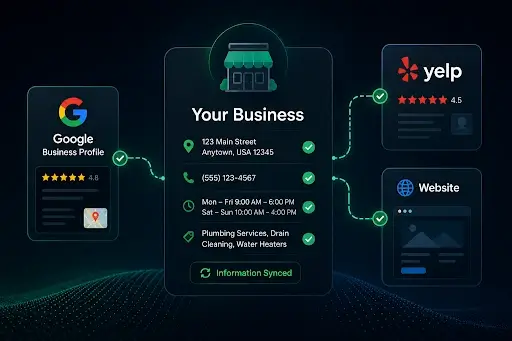
Where to check first: Google Business Profile, Yelp, Facebook, the brand website, and any industry-specific directories.
2. Build a Review Profile Strong Enough to Recommend
A three-star average struggles to earn a recommendation. Review count alone does not change that, since AI treats customer reviews as one of the clearest trust signals available, and the bar for what counts as strong keeps rising. SOCi’s numbers make that bar concrete. Businesses recommended by ChatGPT average a 4.3-star rating, while leading brands on Google sit closer to 4.5.
Star ratings tell half the story. The rest lives in how a business responds to what customers say. A business that replies to nearly every review shows the accountability AI associates with reliability, and speed adds another layer on top of that. A reply within a day signals active reputation review management, while a review left unanswered for weeks signals something else entirely. Review generation deserves the same attention as response habits. A steady stream of new, specific feedback carries more value than one large batch collected and left untouched.
Four factors decide how much weight a review carries with AI:
| Review Factor | Why It Matters to AI |
| Volume | More reviews give AI more data points to draw from |
| Recency | Recent reviews signal an active, currently relevant business |
| Sentiment | Consistently positive reviews build measurable trust |
| Specificity | Detailed reviews help AI understand exact strengths |
AI-Ready Review Response Templates
A generic reply reads as generic to AI, too. The templates below work as a starting structure, not a script to copy word for word. Swap in specifics for each review: the exact service mentioned, the specific complaint, the real fix, and the response stops sounding automated to both the customer and the system reading it.
| For positive reviews: “Thank you for taking the time to share your experience, [Customer Name]. We’re glad to hear that [specific benefit mentioned] made a difference for your team. Feedback like this helps us keep improving, and we appreciate your trust in [Brand Name]. Reach out any time you need support.” |
| For negative reviews: “Thank you for the honest feedback, [Customer Name]. We apologize that [specific issue] did not meet expectations. Our team has already [specific action taken to resolve]. Contact [Name/Email] directly so we can address this personally.” |
| For mixed or neutral reviews:
“Thank you for sharing this, [Customer Name]. We’re glad [specific positive point] worked well, and we hear you on [specific concern]. We’re taking that feedback to [specific team or action], and we’d welcome the chance to make the next experience better.” |
3. Publish Content That Answers Real Questions, Not Just Keywords
AI search behaves conversationally. A search for “bank near me” and a question like “which bank branch nearby works well with small businesses” pull different kinds of content, and only the second reflects how people phrase questions to an AI tool.
Generic service pages struggle here. Experience-driven content, built around specific use cases and local context, gives AI something concrete to match against a nuanced question. A page stating “we offer banking services” answers nothing an AI system can act on. A page explaining which services fit a small business owner, and why, gives AI language it can echo back to a user.
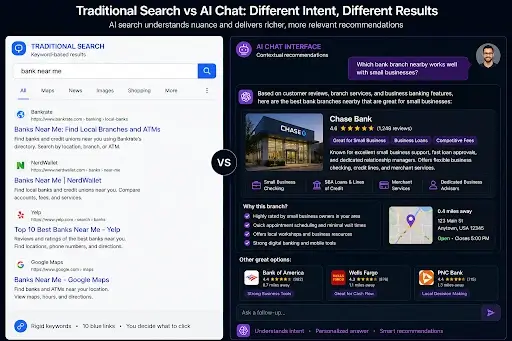
What differentiated content looks like: location-specific service pages instead of one generic page, explanations of who a service fits rather than just what it includes, and content structured around real question phrasing. This approach improves AI visibility because conversational, detailed content gives AI systems a clearer match between a user’s question and the specific service or business that can answer it.
4. Earn Mentions From Sources AI Already Trusts
A brand’s own website carries only part of the weight. Third-party brand mentions, coverage from review platforms, industry publications, and news sources, round out the picture AI assembles, since outside corroboration checks a brand’s self-description against independent sources.
Third-party brand mentions work best when they come from sources relevant to the industry itself. A healthcare brand benefits more from a mention in a medical publication than from a generic directory listing. Building this kind of brand authority takes ongoing outreach: guest contributions, expert commentary for journalists, and steady presence on the review platforms customers already check.
5. Add Structured Data AI Can Read
Content written for a human reader and content readable by an AI crawler aren’t always the same thing. Structured data, schema markup for services, locations, reviews, and FAQs, gives AI systems an unambiguous way to parse a page instead of inferring meaning from unstructured paragraphs.
This matters especially for local businesses. Local search signals, such as location schema and service-area markup, help AI match a business to a specific geographic question instead of a broad category search. A business without this markup still gets read, but AI has to work harder to extract the same information, and that extra inference raises the odds of an incomplete or wrong answer reaching a customer.
6. Build a Consistent Brand Narrative Across Channels
The first five strategies work as separate levers, but AI does not read them separately. A business with accurate listings and weak reviews still struggles. A business with strong reviews and generic content still loses out to a more detailed competitor. AI builds one composite picture from every available signal, and a gap in one area can undercut strength built elsewhere.
Brands searching for how to build AI-ready brand signals often expect a single fix. The real work happens elsewhere: not in any one channel, but in how well those channels agree with each other.
Why alignment matters:
If a website describes a service one way, reviews describe it another, and a directory listing says something different again, AI has three competing versions of the same fact and no clear way to decide which one to trust. Consistency removes that ambiguity, and it is one of the more overlooked parts of AI reputation management.
How to align signals in practice:
- Audit what each channel currently says. Pull the exact service descriptions, hours, and claims live on the website, Google Business Profile, review platforms, and any third-party directories. Differences surface fast once they sit side by side.
- Set one canonical version of the facts. A single internal reference document, covering services, hours, locations, and positioning, gives every team the same source to work from.
- Assign ownership per channel. Listings, reviews, content, and PR often sit with different teams. Alignment breaks down when no one owns the comparison across all four. Consistent messaging also strengthens AI brand visibility, since AI systems have a clearer picture of what the business offers when the same core facts and differentiators appear across multiple trusted sources.
- Review the alignment on a schedule. A new service, a location change, or a rebrand can quickly throw channels out of sync. A quarterly pass catches drift before AI catches it first.
| Signal | Where It Lives | What Alignment Looks Like | Typical Owner |
| Business listings | Google Business Profile, Yelp, Facebook, website | Same hours, phone number, and service list everywhere | Local SEO/operations |
| Reviews | Google, Yelp, industry-specific sites | Ratings and responses reflect the same tone and facts | Customer service/marketing |
| Website content | Service pages, blog, FAQs | Descriptions match what listings and reviews claim | Content team |
| Third-party mentions | Press coverage, directories, industry publications | Consistent positioning and service description | PR/marketing |
| Structured data | Schema markup across the site | Reflects the same facts as listings and content | SEO/development |
By now, you may already have the answer to how to improve brand trust in AI search: make the facts already published agree with each other. Nothing new needs to be built. A brand with accurate listings, active reviews, specific content, and credible third-party mentions, all repeating the same story, gives AI little reason to hesitate. This kind of consistency builds industry authority and strengthens brand visibility in AI search without adding a single new asset.
Turn Your Brand Into an AI-Trusted Authority
How Do You Get Recommended by ChatGPT, Google AI Overviews, and Other AI Tools?
Getting recommended by artificial intelligence isn’t luck. It comes down to authority, consistency, and relevance- the signals every AI platform checks before naming a brand. If you are searching for how to get recommended by ChatGPT or Google AI Overviews, both start here, then split by platform below.
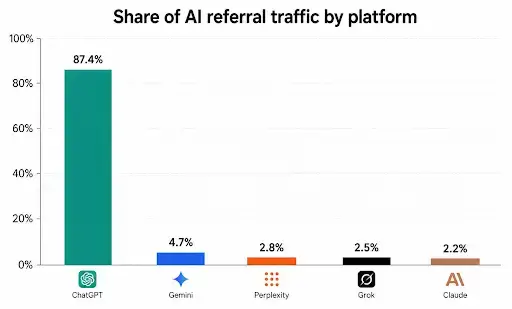
One platform earns most of the attention for good reason. Recent industry data show that ChatGPT accounts for 87.4% of AI referral traffic across the major platforms, well ahead of Gemini at 4.7%, Perplexity at 2.8%, and Claude at 2.2%. A brand’s ChatGPT presence carries outsized weight simply because of where the traffic already is.
How to Get Recommended by ChatGPT
- Build presence where ChatGPT looks for confirmation. A business’s own claims about itself carry less weight than what outside sources say about it. Third-party mentions across review platforms, forums such as Reddit, and industry publications back up a claim in a way a features page cannot do alone.
- Front-load the direct answer before the supporting detail. ChatGPT tends to pull more from the start of a page than from the rest. Recent studies found that 44% of ChatGPT citations come from the first third of a page’s content, which means the opening paragraphs carry more citation weight than anything that follows.
- Consider a Wikipedia or Wikidata entry when a business qualifies. Knowledge panels built from these sources feed several AI systems at once, not just one, which makes this one of the higher-leverage moves on this list for an eligible business.
- Keep testing with the audit prompts covered earlier in this guide. ChatGPT’s sources and training data shift over time, so a strong answer today doesn’t guarantee results next quarter.
Together, these four steps answer both how to get recommended by ChatGPT and the broader question of how to improve brand visibility in ChatGPT, since visibility and recommendation strength grow from the same underlying signals.
How to Improve Visibility in Google AI Overviews
Google AI Overviews behaves nothing like a chatbot conversation. It draws its summary from content already ranking well in organic search, then blends that with structured data and local business signals. The result compresses into a short answer sitting above the traditional results.
- Rank for the target query in organic search first. AI Overviews tends to summarize what already performs well, so a page needs to earn a spot in the results before it can earn a spot in the summary above them.
- Answer the core question within the first few sentences of a page. AI Overviews tends to lift text it can extract without interpretation, and content structured for Google AI Overviews optimization puts the answer first, then follows with supporting detail. The weighting behind that practice is measurable. Recent studies found that 44.2% of all LLM citations come from the first 30% of a page’s text. That makes the introduction and early sections carry weight beyond their share of the page, a detail worth remembering when deciding what goes first.
- Keep a complete, accurate Google Business Profile. Local and business-specific queries draw heavily from profile data: hours, categories, services, and attached reviews all feed into what the Overview says about a business.
- Add schema markup that matches the page’s content, such as FAQ, HowTo, or LocalBusiness schema. Structured data gives Google’s system an unambiguous way to extract facts instead of inferring them from prose.
- Demonstrate real experience and sourcing on the page itself. Google’s own guidance for AI-generated summaries favors original, people-first content over thin or templated pages, the same standard covered earlier in this guide.
Getting Recommended Across Other AI Platforms
Each remaining platform draws its answer from its own mix of sources. The fastest way to move the needle looks different depending on which tool a business wants to reach.
| Platform | What Moves the Needle |
| Gemini | A complete, accurate Google Business Profile, connected structured data, and a solid presence in Google’s Knowledge Graph |
| Perplexity | Citations inside articles and sources Perplexity already treats as reputable, since it leans heavily on visible sourcing |
| Microsoft Copilot | An active LinkedIn presence, professional directory listings, and content indexed well on Bing, including Bing Places |
| Claude (Anthropic) | Clearly structured content with sourced claims and demonstrated expertise, rather than promotional language |
Bringing It Together
Every platform rewards the same behavior: give it something specific, sourced, and corroborated to work with, instead of language built for a human skimming a homepage. That’s the simple answer to how to get your business recommended by AI, regardless of which tool a customer happens to use. A business that does this earns AI-generated recommendations across several platforms at once, building stronger AI visibility instead of relying on a single tool to drive all its discovery.
What Mistakes Hurt Your Brand’s AI Reputation?
Every strategy in this guide has an opposite: a shortcut that quietly undoes the work. Some mistakes are easy to spot. Others build up slowly, one outdated listing or one ignored review at a time, until a business stops showing up in the answers that matter. Knowing how to improve your brand’s AI reputation means recognizing which of these habits is already working against it.
| Mistake | Why It Hurts AI Reputation |
| Inconsistent business listings | AI reads conflicting hours, numbers, or addresses as a low-reliability signal |
| Ignoring or delaying review responses | Signals inactive management, one of the clearest AI reputation red flags |
| Buying or incentivizing reviews | Carries legal exposure under the FTC’s 2024 rule and undermines the trust the reviews were meant to build |
| Thin, generic content | Gives AI nothing specific to cite or repeat back to a user |
| No third-party mentions | Leaves AI with only the brand’s own claims to work from, and no outside source to check them against |
| Missing structured data | Forces AI to infer facts from prose instead of reading them from clear markup |
| Optimizing for a single AI platform | Leaves gaps open on every platform that weighs a different mix of signals |
| Treating reputation as a one-time fix | Misses the drift a regular AI reputation audit is built to catch |
Two symptoms tend to trace back to this list more than any other. A business asking why doesn’t ChatGPT recommend my business usually finds thin content or a missing third-party trail somewhere in the answer. A different question points to a different problem. A business asking why is my business not appearing in AI search usually finds an inconsistent listing or a missing piece of structured data instead. Neither issue is hard to name, only tedious to fix. The fix for both already sits somewhere in this guide, whether that means correcting a listing, adding schema, or building a new third-party mention.
Final Thoughts
We believe this detailed guide helps you understand how to improve your brand’s AI reputation, from auditing what AI already says to strategies that close the gaps. None of this locks into place once. AI reputation shifts with each new review, model update, and competitor working toward the same signals. Because of that, ongoing monitoring, platform testing, and citation building can be hard to fit into an already full schedule. Working with specialists in AI answer engine optimization, like Marqade, is one way to keep that work consistent without it competing for time against everything else already on a team’s plate. The businesses that show up in AI-generated answers a year from now are the ones building that reputation today.
FAQs (Frequently Asked Questions)
LLM stands for large language model, the technology behind tools like ChatGPT, Gemini, and Claude. It trains on massive amounts of text, then predicts the next likely word based on learned patterns, using a transformer architecture to track context across a page, rather than reasoning like a human mind.
Traditional online reputation management focuses on rankings, star ratings, and content a brand controls. AI reputation depends on how AI synthesizes reviews, listings, and third-party sources into one answer, without visiting the brand’s own website first. A business can rank well and still get a flawed description.
AI Overviews and chatbot answers now sit above traditional results, so weak AI reputation can reduce clicks even when a page ranks well. Strong reviews, structured content, and third-party mentions tend to support both rankings and AI search visibility, since the same underlying systems read them.
Few dedicated AI reputation monitoring tools exist yet, so most businesses combine manual prompt testing across ChatGPT, Gemini, and Perplexity with existing tools. Google Alerts flags new brand mentions, and review monitoring platforms track feedback across Google, Yelp, and industry-specific sites.
Getting mentioned starts with giving AI something to find. Third-party mentions, active review profiles, and content built around real customer questions raise the odds an AI model surfaces a business. A brand absent from outside sources appears less across AI-generated answers.
Yes. AI models weigh patterns, not just averages, so a handful of specific, negative customer reviews can shape AI reputation even alongside a strong overall rating. A thoughtful, specific reply signals accountability, while silence reinforces the pattern AI learns from over time.
In many cases, yes. The same signals that build traditional online reputation management- reviews, accurate listings, third-party coverage- feed into what AI models learn about a business. A head start still leaves AI-specific factors like structured data needing separate attention.
Most businesses see measurable shifts within one to three months of consistent work, though results vary by platform and industry. Listing fixes and review responses show up in Google-based tools within weeks, while earning third-party mentions with ChatGPT takes longer to build.
Small businesses can compete here, needing less effort than larger brands with many locations to manage. A single-location business has fewer listings to keep consistent and a smaller review base to track. AI models favor accurate, well-corroborated information over company size.
AI understands a business through signals covered throughout this guide: accurate listings, active reviews, specific content, and third-party mentions. Generic descriptions give AI little to work with, while a clear service, audience, and differentiator give AI language it can repeat with confidence.

Patt Cummins is a technology and digital marketing writer specializing in SEO, content marketing, SaaS, blockchain, and emerging technologies. With a talent for simplifying complex topics, Patt creates informative, research-driven content that helps businesses improve online visibility, engage audiences, and stay ahead in today's fast-evolving digital landscape.
Get Your Free SEO Plan