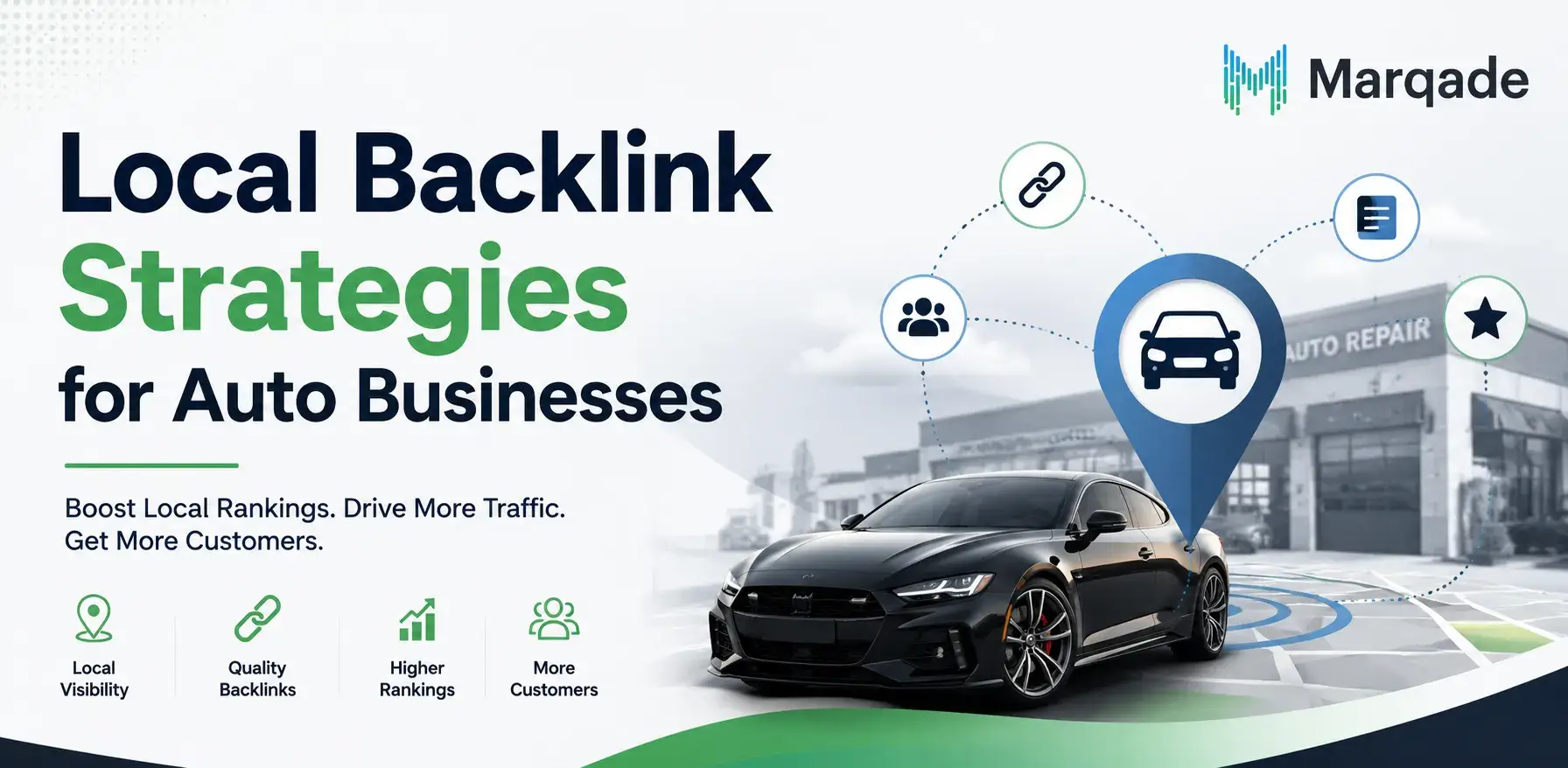
Local Backlink Strategies for Auto Businesses
Get a quick blog summary with:


- Local backlinks help auto businesses build geographic relevance and trust, making it easier to appear in local search results and reach nearby customers.
- Prioritize relevant, high-quality links over quantity—automotive websites, local publications, business groups, and trusted community organizations are more valuable than generic directories.
- Clean up local citations first by keeping your business name, address, phone number, hours, and website consistent across Google Business Profile and other directories.
- Build relationships with local businesses, chambers, teams, and events to earn natural backlinks through partnerships, sponsorships, referrals, and community involvement.
- Get featured by local news sites and automotive bloggers by offering expert opinions, seasonal car advice, business milestones, and other genuinely newsworthy stories.
- Use community-focused initiatives such as scholarships, charity support, and local automotive programs to earn trustworthy links while strengthening your brand reputation.
- Track backlink quality and SEO impact, focusing on relevant referring domains, local visibility, organic traffic, leads, and conversions rather than simply counting links.
Most people looking for a mechanic or a new car start the same way: they open Google and search nearby. That habit has quietly become the entire game for local auto businesses. Your shop might have five-star reviews and loyal customers who keep coming back.
Still, in that same search, you are nowhere to be found, buried under a dozen competitors, some with worse ratings than yours. What’s happening here? It usually comes down to one thing: link building, the quality backlinks from other trustworthy local websites that tell Google your business deserves to rank in your area. Repair shops and dealerships build these links differently, though the goal stays the same.
So, If you are looking for practical ways to build Local Backlink Strategies for Auto Businesses, this guide will give you a realistic place to start.
Why Are Local Backlinks Important for Auto Businesses?
Local backlinks matter for auto businesses because they signal geographic relevance and trust to Google. They are an important part of local SEO for automotive businesses and can support repair shops and dealerships looking to improve their visibility in local search results. For both repair shops and dealerships, the strongest local link building for automotive businesses usually starts with real connections to the communities and customers they serve.
Since customers are bound by location, search algorithms lean on these regional connections to decide who deserves the top spots on Google Maps. For example, a link from your city’s chamber of commerce, a local news feature, or a neighborhood blog tells Google your business has real, local ties. That is the core value of local backlinks for auto businesses: they attract the drivers most likely to visit your shop or lot.
It also builds the business credibility customers need before making a decision like a repair or a car purchase. Quantity is not the goal here. A single relevant, local link often outranks a dozen generic ones, because for automotive local SEO, relevance beats volume every time. The best local backlink strategies for auto businesses focus on earning links that make sense for both the business and the local audience.
Turn Local Google Searches Into Paying Customers With Automotive SEO
How Google Evaluates Your Automotive Backlinks
Google evaluates automotive backlinks by looking at industry relevance, geographic relevance, and the overall trust profile of the linking site. The strongest local backlink strategies for auto businesses focus on three things: whether the linking website is relevant to your industry, whether it has a genuine connection to your location, and whether it is a source people can trust. Here’s what that looks like in practice:
Industry Relevance
Links from auto directories, parts suppliers, or automotive blogs simply carry more weight than a random, unrelated directory listing. Why? Because Google is also checking whether the site linking to you is seen as a legitimate voice in the auto space. A car blog with real readership counts. A generic “submit your business” page usually does not.
Geographic Relevance
This is where location does the heavy lifting. Google looks for links from local news outlets, chambers of commerce, and nearby business groups- anything that confirms your shop or dealership serves a real, physical market. And the site linking to you should actually match where you operate. A link from a site three states away will not do much for your local SEO backlinks, no matter how well-known that site is.
Quality and Trust Signals
Not all domains are created equal. One with real traffic and active engagement passes on far more value than a page that looks half-abandoned. It’s also worth knowing that Google tends to spot bulk-bought or spammy link patterns fairly easily, so leaning on shortcuts like that usually backfires more than it helps.
One quick distinction worth making here: not everything that helps your local visibility is technically a backlink. Listings on platforms like Google Business Profile or Yelp are citations, they confirm your name, address, and phone number are consistent everywhere, and often include a link, but their main job is consistency, not link equity. Both matter. They just serve different purposes, which is why the first strategy ahead treats them as a starting point, not the finish line.
This is exactly why local backlink strategies for auto businesses cannot rely on one tactic alone. Relevance, geography, and trust stack together over time, which is also the logic behind local link building for auto businesses. The 8 local backlink strategies for auto businesses ahead were chosen because each one naturally hits at least one of these factors, without requiring a marketing budget or technical skill to execute.
8 Local Backlink Strategies for Auto Businesses
Building backlinks for auto businesses does not require special software or advanced SEO knowledge, just a clear plan and a bit of consistency. That is exactly what the next 8 strategies offer: practical steps you can realistically start this week, using resources most shop owners already have access to. Let’s get started!
1. Fix Your Local Citations
Before chasing new backlinks, make sure the ones you already have are working correctly. Most auto businesses have listings scattered across Google Business Profile and a handful of regional directories, sometimes ones nobody remembers signing up for. If your name, address, or phone number is inconsistent across even a few of these, Google notices, and not in a good way.
This step is technically a citation, not a backlink, but it earns its place as strategy one anyway. Most listings include a live link back to your website, and a messy, inconsistent citation profile can quietly undercut every other link you build later. Think of it as clearing the runway before takeoff.
For auto businesses, this matters more than in most industries. Someone searching “brake repair near me” or “car dealership in [city]” is relying on Google to surface accurate, trustworthy results fast. A dealership with two different phone numbers floating around the web sends mixed signals, and confused algorithms rarely rank confidently.
Here’s how to clean it up:
- Search your business name plus your city on Google, and note every listing that comes up, including ones you did not create.
- Claim any unclaimed listings, starting with Google Business Profile.
- Check your NAP consistency (name, address, and phone number) on each one. They should match exactly, down to abbreviations like “St.” versus “Street.”
- Fix outdated hours, phone numbers, or addresses from a previous location.
- Add your website link wherever the platform allows it; this is often where your first local link comes from.
This groundwork makes every strategy ahead easier to build on. If you are learning how to build local SEO backlinks, start by making sure your business information and existing local profiles are accurate before pursuing new opportunities.
2. Get Listed in Auto-Specific Directories
General business directories help, but auto-specific ones carry extra weight because they signal industry relevance, not just location. This is where automotive link building really takes shape, since these platforms are built around the exact searches your customers are already running.
Repair shops and dealerships benefit from slightly different directories, so it helps to search for each separately. If you are wondering how to get local backlinks for an auto business, start by listing every service you offer, then search for directories built specifically around those services, rather than generic ones.
Backlinks for auto repair shops usually come from service-focused platforms. A shop in the US, for example, may find value in RepairPal or Angi. Most other regions have their own local equivalents worth searching for. This is essentially how to build local backlinks for an auto repair shop, skipping generic listings that have nothing to do with cars in favor of ones built around actual service searches.
Dealerships work a little differently, since buyers usually browse inventory before they ever land on Google. A dealer in the US may look at platforms like Cars.com, CarGurus, or DealerRater, and other regions tend to have comparable alternatives. Getting listed here is a direct answer to how to get high authority backlinks for a car dealership, and it tends to bring in backlinks for car dealerships from people already in buying mode.
Search “[your service] directories in [your country]” to find what’s actually active in your market. Claim each listing, fill it out completely, and add your website wherever allowed.
3. Join Your Local Chamber
Joining a chamber of commerce is one of the oldest local link tactics still around, and it still works. Most chambers list every member business on their website, complete with a link back, and that single line often becomes one of the more overlooked local backlink opportunities for auto businesses.
This strategy applies to dealerships and repair shops alike, but independent, family-run shops without brand name recognition tend to benefit the most. A well-known dealership already carries some built-in trust. A smaller, independent repair shop does not, and a chamber listing helps close that gap by association. This one small effort often addresses a common question, how to improve local authority for an auto business, without any cost beyond time and a phone call.
Beyond chambers, several other local groups offer similar value:
| Group Type | What You Typically Get | Backlink Potential |
| Chamber of Commerce | Member directory listing, networking events | High, direct site link |
| Local business associations | Community visibility, joint promotions | Medium, sometimes a link |
| Trade or industry groups | Niche credibility, occasional features | Medium to high |
| Networking meetups | Relationships, referral introductions | Low direct, but leads to other links |
Membership usually costs a modest annual fee, though some smaller regions offer it free for local businesses. Once inside, do not just pay and disappear. Attend a few events, introduce yourself, and ask directly whether your listing includes a link to your website. Many chambers will add it without hesitation once you ask.
This is a slower-building strategy, but for local link building for auto repair shops especially, it is one of the more dependable long-term plays. For many businesses, this is one of the most sustainable local backlink strategies for auto businesses because the links are supported by genuine local relationships.
4. Partner with Nearby Businesses
Some of the strongest local links come from businesses you already work with informally, just without a website link attached yet. Formalizing those relationships is one of the simplest ways to build local backlinks for auto businesses, since the trust between you already exists. All that is missing is the digital connection.
The right partners depend on what kind of auto business you run. Repair shops tend to have natural overlap with tire shops, auto parts stores, towing companies, and car washes- businesses that already send customers back and forth without any formal arrangement. A simple “recommended local partners” page, with each business linking to the other, turns that existing relationship into a real backlink, and it happens to be one of the more practical local link building strategies for auto repair shops available.
Dealerships work with a different set of partners. Insurance agents, detailing services, rental agencies, and extended warranty providers all interact with car buyers at some point in the ownership journey. A dealership that partners with a local detailer for a “new car prep” package, for instance, has a natural reason for both sites to link to each other, a small but effective addition to broader local link building strategies for car dealerships.
A few ways to start:
- List the businesses you already refer customers to, even informally
- Reach out and suggest a simple mutual link, or a joint blog post, or a shared page
- Offer something in return, a referral, a discount code, or a mention on your own site
- Keep the list updated as relationships change
This approach works because the links feel earned rather than requested out of nowhere, since an actual working relationship backs them up. It also tends to build faster than cold outreach, since you are formalizing something that already exists rather than starting from scratch.
5. Sponsor Local Teams & Events
Sponsorship money often disappears into a banner nobody remembers by the following season. Add one simple condition to the deal, a link on the organization’s website, and the same spend suddenly works twice as hard, building community goodwill and a genuine backlink at the same time.
Most team and event websites list their sponsors somewhere, usually as a logo. What a lot of shop owners don’t realize is that the same page will often link that logo to the sponsor’s website, but only if someone asks for it. Nobody adds the link automatically. That’s the entire strategy here: ask for the link when you sponsor something, and you’ll come away with a real backlink instead of just a logo nobody can click.
For Dealerships
Sponsoring a youth sports team, a school fundraiser, or a community event works well because these organizations tend to run active, regularly updated websites with a dedicated sponsors page. It is a classic local marketing move, but online, it plays out differently than it does on a banner at the field. Once your logo appears alongside a clickable link, it becomes a real, earned signal, not just visibility.
For Repair Shops
Local car shows, cruise nights, and high school auto shop programs tend to work better here, since they are already automotive-adjacent. That overlap matters; the resulting link carries both geographic and industry relevance at once. Donating tools, sponsoring a trophy, or supporting a school’s auto program are all low-cost ways in.
Before you sponsor anything, confirm the link:
- Ask directly whether the organization lists sponsors online, and whether that listing includes a link.
- If they only plan to use a logo image, request that the logo be hyperlinked to your site.
- Check their website a few weeks after the event to confirm the link actually went live.
- Mention the sponsorship on your own site too; this creates a two-way local signal instead of a one-sided plug.
Not every sponsorship needs a large budget. A small contribution to a car show trophy, or a modest season sponsorship for a local team, often performs just as well online as a far bigger spend, provided the link gets added. It is a small, deliberate move, but it belongs on any real list of best local link building strategies for auto businesses, since it pairs community presence with a link that is genuinely earned.
6. Get Quoted by Local News & Bloggers
A quote in a local news story or a mention on a community blog does more than build a link; it builds instant credibility. These sources tend to carry real authority in Google’s eyes, and they are often easier to land than owners expect. Journalists and bloggers are not looking for perfect PR pitches; they are looking for a real story, a real quote, and someone who actually picks up the phone.
Story angles that tend to get picked up:
- “Local dealership becomes the first in [city] to stock EVs” — dealerships have an easy edge here, since inventory shifts are naturally newsworthy
- “Family-run shop celebrates 20 years serving [neighborhood]” — milestones work well for repair shops chasing local SEO for auto repair shops
- A shop owner commenting on rising parts costs, or a seasonal maintenance tip, whenever a local reporter is covering car-related news
- Sponsoring or hosting something the local blog would want to feature anyway, tying back into the previous strategy
Getting quoted is mostly about outreach, not writing skill. A short, direct email works better than a polished press release:
| Subject: Local car expert available for [topic] stories
Hi [name], I run [business] here in [city] and noticed you cover local business and automotive topics. Happy to offer a quick quote or expert perspective anytime it’s useful, no pressure, just a resource if it helps. |
Isn’t it simple practice? All you need to do is just send a follow-up reminder after one or two weeks; that’s it.
For dealerships chasing local SEO for car dealerships, local news coverage around new inventory, community events, or milestones tends to land fastest. For repair shops, seasonal advice pieces (winter car prep, road trip checklists) give local bloggers an easy, evergreen angle to write around, often becoming one of the more natural local backlink strategies for auto businesses on this entire list.
7. Offer a Scholarship or Give Back Locally
Most local link building strategies for auto businesses earn a mention from a blog or a directory. This one can earn something rarer: a link from a .edu domain, which Google treats as one of the most trustworthy sources on the web. Educational institutions rarely link out casually, so when they do, that link carries real weight.
The most effective version of this strategy is a small scholarship tied to a local vocational or trade school’s automotive or diesel technology program. Schools list scholarship sponsors on official pages, almost always with a link back to the sponsor’s website, and that single link often does more for trust signals than a dozen directory listings combined.
| Give-Back Option | Link Source | Trust Value |
| Scholarship for auto/diesel tech students | School or program website (.edu) | Very high |
| Sponsor a school’s auto shop equipment | School website, newsletter | High |
| Donate to a local charity or food bank | Charity website, press mention | Medium |
| Support a community fundraiser | Event or nonprofit site | Medium |
A scholarship does not need to be large to qualify. Many programs accept modest annual contributions, and what matters more than the dollar amount is that it is offered consistently, year after year, since schools tend to favor long-term supporters over one-time donors when listing sponsors.
This single strategy plays a bigger role than its size suggests in how to improve local authority for an auto business, precisely because trust, not volume, is what search engines reward most. A general charity donation still helps, but if only one give-back effort makes the list this year, the scholarship route is the one worth prioritizing first.
8. User-Generated Content for Backlinks
Automotive local SEO is shifting toward content a business does not have to produce itself. Customer photos, reviews, and testimonials carry a kind of trust no service page can replicate, and that trust is exactly what makes them link-worthy. Industry surveys estimate that over 60% of buyers say content from friends or family shapes their purchase decisions, which explains why this has become one of the more reliable local backlink opportunities for auto businesses willing to put in a small amount of structure.
The most useful customer content usually falls into three types:
- Photos: before-and-afters, new car pickups, detail jobs, custom work
- Reviews: first-hand accounts posted on Google, Facebook, or a dedicated page on the business site
- Testimonials: short quotes from happy customers, featured with permission
Simply asking tends to work better than most owners expect. A short follow-up message after a repair or sale, asking for a quick photo or a few lines about the experience, brings in more usable content than waiting for it to happen on its own. For backlinks for auto repair shops, timing the ask right after a completed job tends to get the best response. For backlinks for car dealerships, the ask fits naturally into the post-sale follow-up most dealerships already send.
Feature the strongest submissions on a dedicated page on the business site instead of leaving them scattered across social media. That page becomes something local blogs and directories can reference, turning routine customer content into authentic link building rather than another unlinked review widget.
Grow Your Auto Repair Shop With Proven Local Link-Building Strategies
When DIY Isn’t Enough: Backlink Strategies That Need Expert Support
The local backlink strategies for auto businesses covered earlier are practical starting points for most shop owners and dealership teams. Cleaning up business listings, joining local organizations, and sponsoring local events all create genuine local backlink opportunities for auto businesses, and none of it requires advanced SEO skills.
As competition increases, though, local link building for automotive businesses starts to demand more than a checklist. Identifying the right opportunities, analyzing what competitors are already earning, and creating content worth referencing takes considerably more time and expertise than most in-house teams can spare.
Competitor Backlink Analysis and Link Gap Research
A competitor backlink analysis reveals the websites, publications, and local resources already linking to competing businesses. If several competitors have all earned local backlinks for auto businesses from the same regional publication or automotive association, that overlap is rarely a coincidence, and it’s usually worth investigating.
The hard part isn’t collecting a long list. SEO tools return hundreds, sometimes thousands, of results without much effort. The real expertise is in the filtering: knowing which opportunities are relevant, realistic, and capable of supporting broader automotive local SEO goals.
This is also why link building should be measured against business outcomes rather than link volume alone, as shown in this case study on a 70% increase in organic traffic. Sustainable growth comes from connecting the different parts of a strategy together, not treating link building as an isolated task.
Digital PR and Editorial Outreach
Some of the strongest local backlinks for auto businesses come from sites with no submission form to fill out at all. Regional news sites, automotive publications, and community resources fall into this category, and earning a mention usually means having something genuinely worth publishing: expert insight, useful data, or a story a reporter would actually want to tell.
That’s what makes local link building for auto repair shops and local link building strategies for car dealerships more demanding than a directory submission. It takes research, a strong angle, and personalized outreach, more dedicated hours than most owners can spare alongside running the business itself.
Create Content and Video Assets Worth Referencing
For anyone wondering how to get more local backlinks, creating something genuinely useful enough for other sites to reference is one of the strongest long-term plays available: local buying guides, seasonal maintenance resources, original research, or educational video content.
Publishing on its own doesn’t automatically earn local SEO backlinks, though. The content still needs a useful angle, strong execution, and a real plan for reaching the people who’d actually reference it, which is where professional support tends to earn its keep.
Use AI Search
ChatGPT now captures 4.33% of the search market. Users are no longer relying only on short keyword searches and pages of traditional search results. Instead, they are asking complete questions and getting direct, conversational responses.
For auto businesses, this changes how potential customers discover local services. Someone looking for a repair shop may ask, “Where can I get my hybrid car serviced near me?” rather than searching only for “hybrid repair shop.” As a result, businesses need to consider how their content appears in AI-generated answers. This shift is already changing AI SEO for automotive businesses, with greater emphasis on natural language, clear answers, topical relevance, and content that directly addresses customer questions.
How to Track If Your Backlink Strategy Is Working
Building links means nothing if there’s no way to tell whether they’re actually helping. Tracking doesn’t require a dashboard, though the right tools do make patterns easier to spot as the list of links grows.
Tracking Backlink Without Any Tools
A few manual checks catch most of what matters, especially early on:
- Search the business name and city on Google every few weeks, and note any new mentions, features, or listings that show up
- Revisit every promised link (a chamber listing, a sponsorship page, a guest post) directly to confirm it actually went live, and stayed live
- Watch for customers who mention finding the business through a specific article, sponsorship, or partner site
- Note any jump in calls, direction requests, or walk-ins that lines up with a link going live somewhere
None of this needs a subscription, just a recurring reminder to check.
Tracking Backlink With Tools
| Tool | What It Shows | Best For |
| Google Search Console (free) | Which sites link to the website, and which pages earn the most links | Confirming new backlinks are actually indexed and counted |
| Google Analytics (free) | Referral traffic from specific linking sites | Seeing which links send real visitors, not just which ones exist |
| Ahrefs / SEMrush / Moz (paid) | Full backlink profile, domain authority, competitor comparison | Ongoing monitoring once the link list grows past a handful of sites |
Search Console is usually the right starting point. It’s free, and it shows exactly which of the links built through this guide have been picked up by Google. Paid tools become worth the cost once the backlink list from chambers, directories, sponsorships, and guest features grows large enough that a spreadsheet stops being enough to track it manually.
When Expert Support Makes Sense
Every strategy covered in this guide, from basic citations to competitor gap analysis, can theoretically be run in-house. In practice, most shops and dealerships handle the foundational tactics well on their own, and start running out of bandwidth once the work shifts toward research, outreach, and technical execution.
A few signals tend to show up around the same time:
- Competitor backlink data exists, but nobody has time to filter it into a real opportunity list
- Editorial outreach gets attempted once or twice, then quietly stops
- Content gets published, but rarely earns a link back from anywhere
- Multiple locations need individual local relevance without breaking the site’s overall structure
- Link building efforts and technical SEO issues aren’t talking to each other
These signals usually point to one thing: local link building for auto businesses has outgrown what a part-time effort can sustain, especially once it needs to run alongside content strategy, technical SEO, and ongoing performance tracking rather than as a standalone task.
This is the point where working with a specialist automotive SEO agency like Marqade can make the process easier to manage and more connected to your wider growth goals. These experts earn high quality backlinks for auto businesses that strengthens the pages you want to rank. They improve long-term search visibility, bring more qualified traffic, and help your business build a stronger position against local competitors over time.
Boost Your Auto Business Rankings With High-Quality Local Backlinks
Common Mistakes to Avoid With Local Link Building for Auto Businesses
A few habits quietly undo the progress made by the strategies covered above. Most of them are easy to avoid once they’re visible.
Treating citations as backlinks
A listing on Google Business Profile or Yelp confirms name, address, and phone number consistency. It isn’t the same as an earned local backlink, and building a strategy that stops at citations misses most of the actual value covered earlier in this guide.
Chasing link volume over relevance
A hundred generic directory links do less than a handful from sites with real local or automotive relevance. Google tends to spot bulk-bought or spammy patterns easily, and leaning on them usually backfires rather than helps rankings.
Letting NAP details go inconsistent
An outdated phone number on one directory and a slightly different address on another sends mixed signals. It undercuts every other link built afterward, which is exactly why fixing citations comes first in any real local backlink strategies for auto businesses.
Sponsoring or partnering without confirming the link
A logo on a sponsors page isn’t the same as a hyperlink. Many sponsorships and partnerships never convert into an actual backlink simply because nobody asked, or nobody checked back after the event to confirm it went live.
Going for one-time efforts instead of consistency
A single guest post, one chamber membership, or a scholarship offered once rarely moves the needle. Schools, publications, and local organizations tend to favor businesses that show up year after year over one-time contributors.
Ignoring the technical side of the site
A strong backlink pointing to a slow, poorly structured, or thin page carries far less weight. Backlinks amplify whatever the destination page can already support, they don’t fix it.
Skipping tracking altogether
Building links without checking whether they went live, stayed live, or brought in traffic makes it impossible to tell which efforts are actually working, and which ones are wasted time.
Conclusion
Local backlink strategies for auto businesses don’t take much to get moving: clean up citations, join a chamber, partner with the shop down the street, ask a happy customer for a quick photo or review. Stick with it and the rankings follow.
Competitors keep earning new links, though, and a website’s technical health can cap what any of those links are worth. A specialist automotive SEO agency tracks both sides, leaving a shop or dealership free to focus on customers instead of spreadsheets.
FAQs (Frequently Asked Questions)
Cleaning up citations is the starting point, since inconsistent listings undercut every link built after them. From there, joining local organizations and forming nearby business partnerships are some of the more reliable local backlink opportunities for auto businesses, and neither need paid tools or technical skill.
Service-specific directories and local chambers form a solid base for backlinks for auto repair shops. Sponsorships tied to something automotive, a school auto program or a local car show, tend to carry more weight than a generic one, since Google reads that overlap as real local relevance.
Dealership platforms like Cars.com or DealerRater help, but community sponsorships and local news coverage around new inventory or a milestone often bring in stronger backlinks for car dealerships. Staying visible in the community matters here more than filling out another directory form.
Chamber listings, partnerships with related businesses, event sponsorships, and school scholarships all count as genuine local backlink opportunities for auto businesses. Each one carries a different kind of trust, geography, industry relevance, or plain institutional authority, and they perform best stacked together rather than run alone.
No single tactic carries an entire automotive backlink strategy on its own. Low-effort wins like citations and directories pair well with slower, relationship-based ones like sponsorships and partnerships, and that combination consistently outperforms any one approach run in isolation.
Consistent NAP details across every listing are the foundation of automotive local SEO. On top of that, links from trusted local sites and a technically sound website do most of the heavy lifting, treated as an ongoing habit rather than a one-time fix.
Building real local SEO backlinks starts with citations, then layers in directories, partnerships, sponsorships, and the occasional press mention. Search engines weigh these together rather than judging any one link in isolation, which is why variety matters more than volume.
Getting more local backlinks over time comes down to consistency: checking that existing links from earlier local link building for auto businesses efforts are still live, following up on ones promised but never confirmed, and revisiting the list every few months instead of treating it as a one-time project.

Patt Cummins is a technology and digital marketing writer specializing in SEO, content marketing, SaaS, blockchain, and emerging technologies. With a talent for simplifying complex topics, Patt creates informative, research-driven content that helps businesses improve online visibility, engage audiences, and stay ahead in today's fast-evolving digital landscape.
Get Your Free SEO Plan