Want To Dominate The Market?
Managing search visibility across thousands of ecommerce pages means targeting different categories, products, and customer searches with a clear strategy. Through technical SEO, category and product optimization, internal linking, structured data, and AI search improvements, we helped DIY.com strengthen its presence across the UK market and emerging search platforms.
1 Year
United Kingdom
Enterprise Ecommerce SEO and AI Search
Organic Traffic
Organic Traffic Value
AI Overview Visibility
ChatGPT Visibility
DIY.com is the online home of B&Q, serving the UK market across building materials, decorating, gardening, kitchens, bathrooms, and home improvement. Its large catalog covers broad category searches, such as “garden furniture,” as well as specific product queries, such as “cashmere dining chairs.”
With thousands of categories and product pages, the site needed to maintain visibility across different search journeys while responding to changes in product and seasonal demand.
The main challenge was connecting a large ecommerce catalog with the different ways customers search.
Broad terms such as “laminate flooring” and “garden furniture” required strong category-level visibility. More specific searches needed the right product or subcategory pages to appear, so users had a clearer idea of what they wanted.
Seasonality added another challenge. Demand across gardening, decorating, and home improvement changes throughout the year, shifting attention between categories and products.
Across a catalog of this size, the priority was to identify which page types needed attention and how each could better support a specific search journey.
Over the one-year engagement, Marqade implemented technical SEO improvements, optimized key category and product pages, strengthened internal linking, enhanced structured data, and improved content for AI-driven search.
The work focused on addressing search gaps across a large ecommerce catalog while tracking changes in organic rankings, page visibility, and AI search presence throughout the engagement.
The one-year engagement covered a complex ecommerce environment with 104,899 organic pages represented in the reporting data. Our work focused on how category pages, product pages, internal linking paths, structured data, and AI search visibility worked together across the wider catalog. Rather than applying the same approach to every page, we focused on the areas most relevant to search performance and product discovery.
We reviewed how organic traffic and visibility were distributed across a large set of pages, helping identify where high-traffic pages and lower-volume catalog pages contributed differently to overall search performance.
We worked across priority commercial categories and deeper subcategory paths to better align important pages with broad and mid-level product searches.
We refined product titles, specifications, page content, and search alignment to better support more specific queries where users were looking for particular products, styles, colors, or attributes.
We strengthened more than 400+ internal links across advice content, category pages, subcategories, and relevant product pages. The work improved pathways to priority commercial pages and created clearer discovery routes across deeper parts of the catalog.
We refined product and availability markup to make important product information clearer and more consistent for search platforms.
We improved content structure and AI search readiness across key page types, supporting wider visibility in Google AI Overviews, and tracked ChatGPT results.
Before setting priorities, we reviewed how organic visibility was distributed across markets, pages, and search terms. Three patterns helped shape the direction of the work.
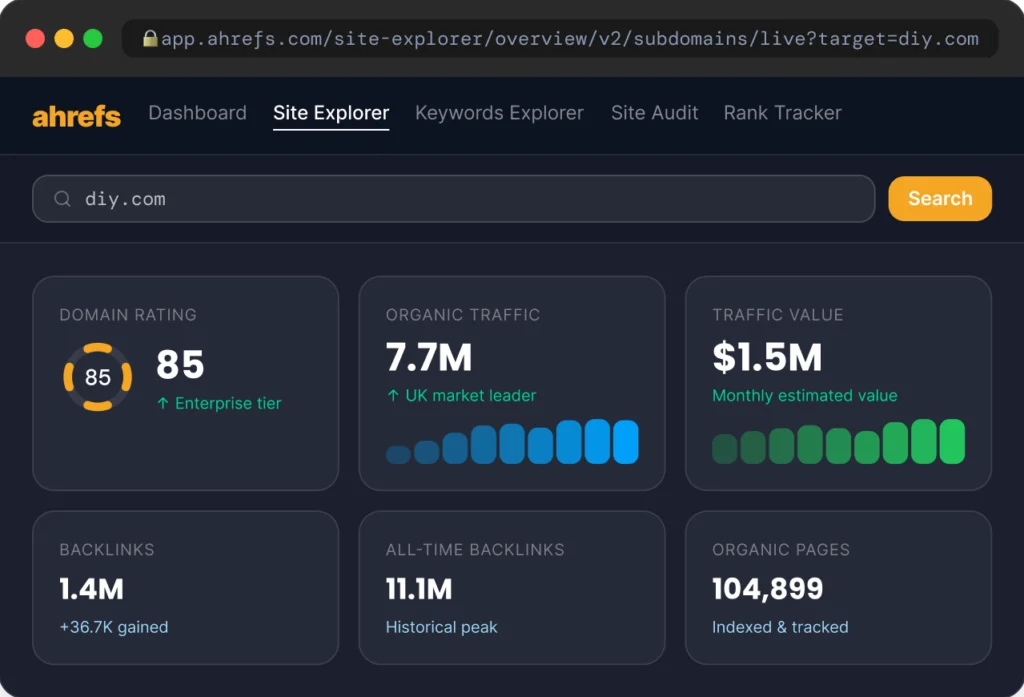
The market data showed that 97% of organic traffic came from the UK, compared with 1% from the US. The same organic search snapshot recorded 7.7M in traffic and an estimated traffic value of $1.5M.
This made the UK the clear priority when reviewing category demand, product searches, and wider organic visibility.
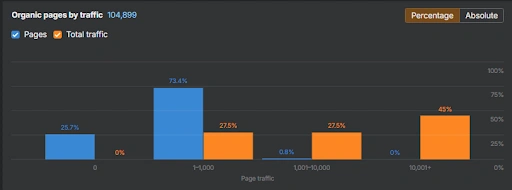
The page-level report covered 104,899 organic pages. Of these, 73.4% fell within the 1–1,000 traffic range and collectively accounted for 27.5% of total organic traffic.
At the other end of the distribution, the highest-traffic band accounted for 45% of total organic traffic.
The pattern showed why the strategy could not focus only on a small set of top-performing URLs. High-traffic pages made a major contribution, while a much larger group of lower-volume pages supported visibility across the wider catalog.
The ranking data showed clear differences between broad category demand and specific product searches.
Terms such as “laminate flooring,” “garden furniture,” and “plywood sheets” reflected broader category-level demand. Searches such as “watering hole wallpaper” and “cashmere dining chairs” pointed to more specific product needs.
This distinction helped separate opportunities by category, subcategory, and product page, rather than treating the entire catalog the same way.
Building on the search data, we focused on specific gaps across category visibility, product discovery, internal linking, crawl paths, and AI search readiness. The approach varied by page type rather than by applying the same SEO changes across the entire catalog.
We mapped broader commercial searches to the category and subcategory pages best suited to satisfy them. This helped separate high-volume category demand from more specific product searches and reduced the risk of multiple page types competing for the same intent.
For priority areas such as Laminate Flooring, Garden Furniture, and Plywood Sheets, we refined heading structures, on-page copy, metadata, and internal relevance signals. The goal was to strengthen the page most closely aligned with each search rather than spreading relevance across overlapping URLs.
Specific product searches required a different approach. We reviewed how deeper product pages matched searches around product names, styles, colors, and specifications.
For terms linked to products such as Watering Hole Wallpaper, Cashmere Dining Chairs, and Egyptian Cotton Paint, we refined product titles, technical details, and page content to better reflect exact search intent. We also reviewed crawl depth so commercially relevant product URLs were not dependent on long or unclear discovery paths.
We reviewed how authority moved between advice content, category hubs, subcategories, and product pages. The focus was on identifying commercially important pages with weak internal pathways and improving how relevant pages connected to them.
As part of this work, we added and optimized more than 400+ internal links across the catalog. Links from supporting advice content were directed toward priority commercial categories where contextually relevant. We also strengthened breadcrumb paths and connections between related products to improve discovery across deeper sections of the site.
We reorganized key product information so important details were easier for search engines and AI systems to identify. Product descriptions, specifications, attributes, and supporting content were structured more consistently rather than leaving critical information buried in uneven page layouts.
We also refined product and availability markup to improve how key attributes were represented. This created clearer machine-readable signals across product pages while supporting visibility in both traditional search and AI-driven results.
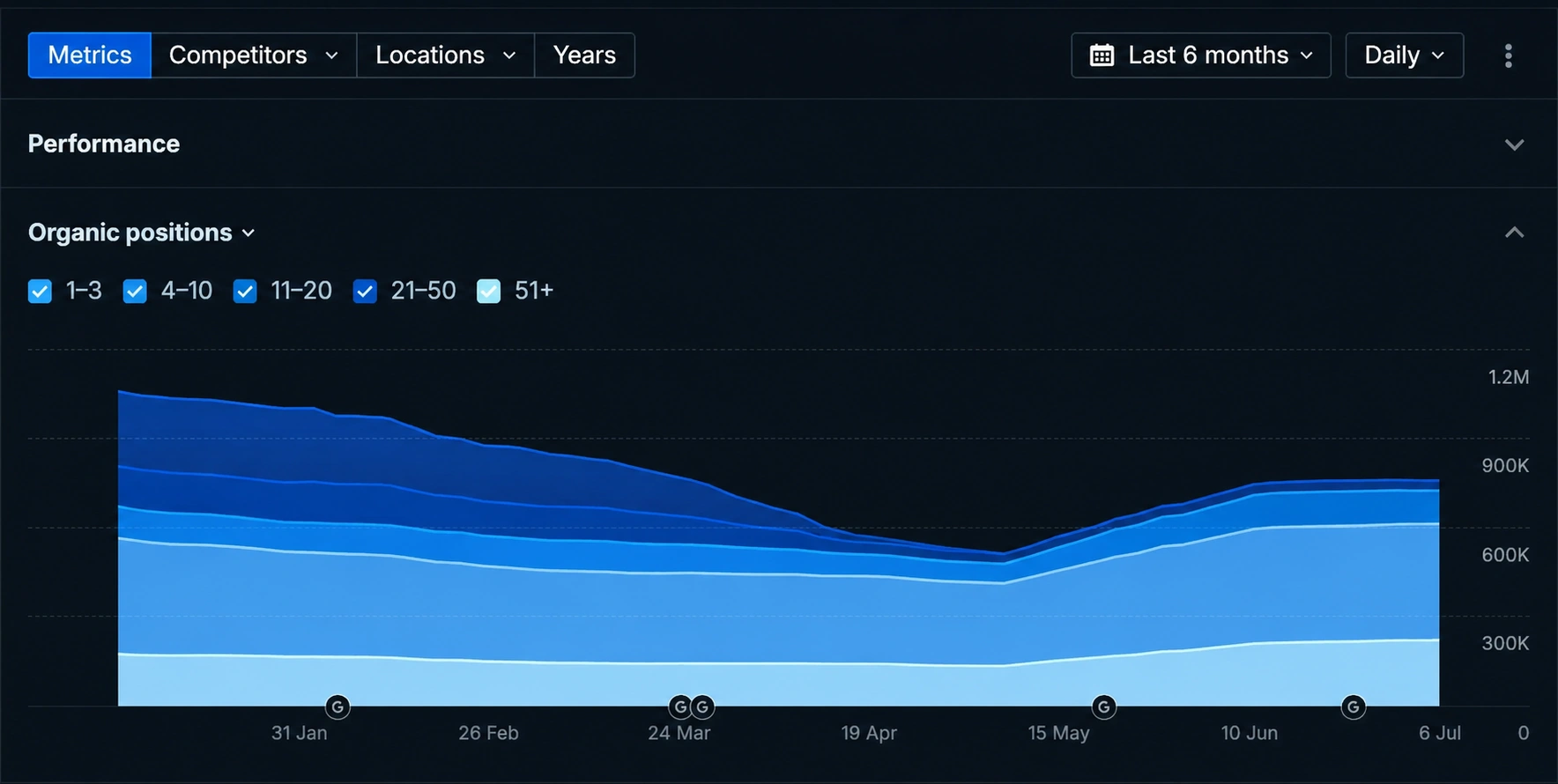
The six-month ranking trend showed a noticeable decline beginning in late March. The downward movement continued through April and reached its lowest point around mid-May. Following the rollout of our core SEO updates, organic positions began to recover through June and continued to rise into early July. The timing of this recovery aligned with the implementation of our category, product, internal linking, and technical SEO improvements. The recovery was visible across multiple ranking groups rather than a small set of isolated terms. Keywords in the Top 3, positions 4–10, and positions 11–20 moved upward during the period, indicating broader improvement across the site’s organic visibility.
Our optimization work helped improve DIY.com’s rankings for searches tied directly to the products and categories it sells. We tracked key terms across the catalog to measure performance for both specific products and broader category searches.
The campaign helped secure #1 rankings for Watering Hole Wallpaper, Cashmere Dining Chairs, and Christmas Lights Clearance. Broader terms also reached strong positions, with Laminate Flooring ranking #3, Plywood Sheets #4, and Garden Furniture #5.
These results show how our optimization work strengthened DIY.com’s presence across exact product searches and broader category terms.
| Search Term | Current Google Position |
|---|---|
| Watering Hole Wallpaper | #1 |
| Cashmere Dining Chairs | #1 |
| Christmas Lights Clearance | #1 |
| Egyptian Cotton Paint | #2 |
| Laminate Flooring | #3 |
| Plywood Sheets | #4 |
| Garden Furniture | #5 |
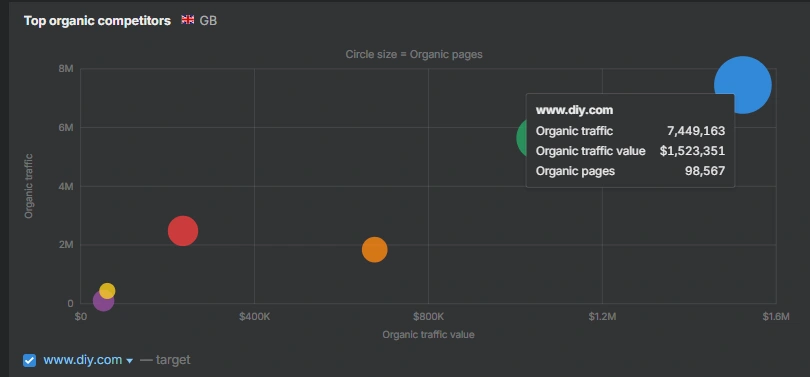
The keyword positions formed part of a much larger UK search presence. In the UK competitor view, DIY.com recorded 7,449,163 in organic traffic across 98,567 organic pages, with an estimated traffic value of $1,523,351.
The competitor chart also placed DIY.com toward the upper end of the comparison set for organic traffic and estimated traffic value. This wider view provides context for the individual rankings, showing the scale of the site’s search presence across the UK market.
Recorded in UK competitor analysis.
Pages contributing to search visibility.
Estimated commercial presence value.
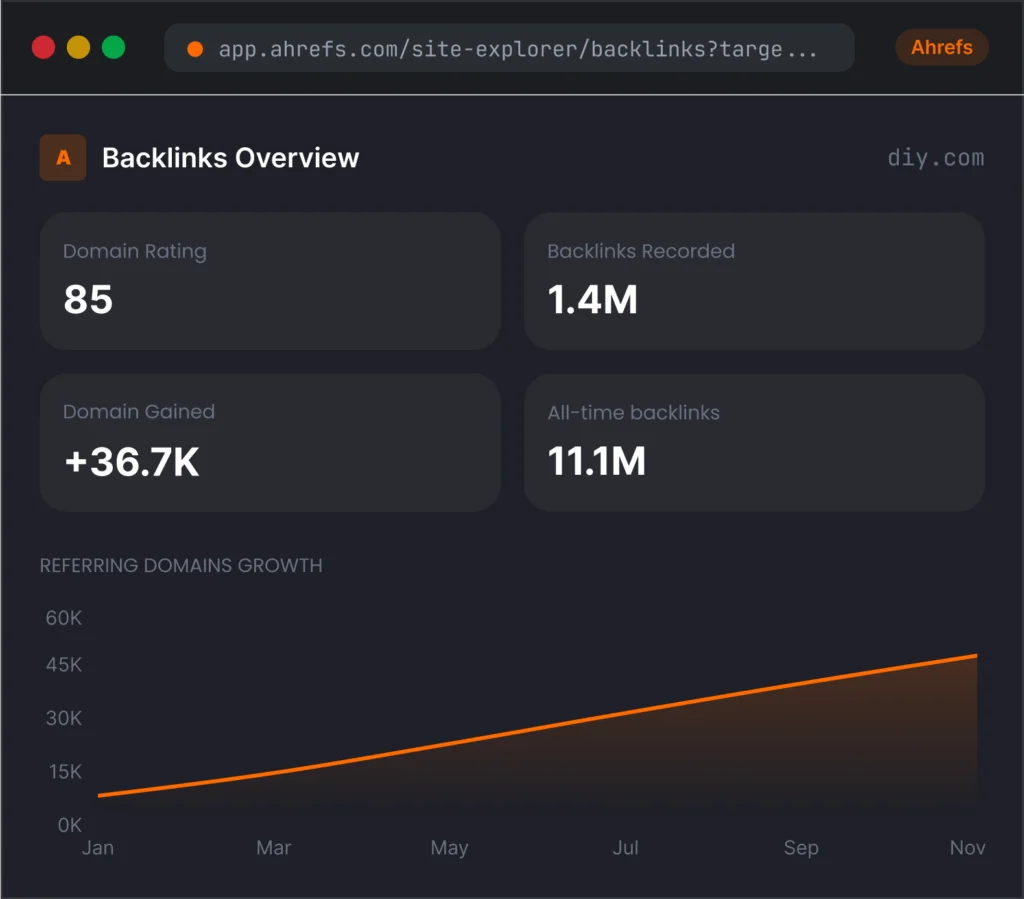
DIY.com’s organic presence was supported by a strong and established backlink profile. The volume of backlinks highlights the website’s overall authority and the level of external recognition it has built over time. For a large ecommerce website with thousands of categories and product pages, this backlink strength provides important support for broader organic search visibility and performance.
Search Engine
Google AI Overviews
During the engagement, Google AI Overview visibility increased from 11.5K to 50.9K, a 343% increase. The number of pages appearing in AI Overviews also grew from 5.9K to 15.4K, extending visibility across a much larger portion of the DIY.com catalog.
| Metric | Before | After | Change |
|---|---|---|---|
| AI Overview Visibility | 11.5K | 50.9K | +39.4K |
| Pages Appearing | 5.9K | 15.4K | +9.5K |
Search Engine
ChatGPT
During the same period, ChatGPT visibility increased from 7.1K to 7.5K, while the number of represented pages grew from 7.1K to 7.9K. Although the absolute visibility increase was smaller than the growth recorded in Google AI Overviews, the wider page coverage showed that more of the DIY.com catalog appeared across tracked ChatGPT results.
| Metric | Before | After | Change |
|---|---|---|---|
| ChatGPT Visibility | 7.1K | 7.5K | +400 |
| Pages Represented | 7.1K | 7.9K | +800 |
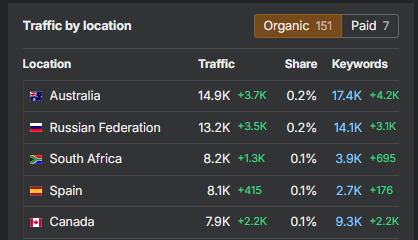
The UK remained DIY.com’s main organic market, but the website also attracted search traffic from several other countries. This wider reach shows that product and category pages were being discovered across markets outside the site’s core UK audience.
Australia recorded 14.9K in organic traffic, followed by the Russian Federation at 13.2K and South Africa at 8.2K. Spain and Canada also contributed 8.1K and 7.9K, respectively.
These markets accounted for a smaller share of total organic traffic, but they still contributed to the website’s overall search presence. The data show that DIY.com maintained its primary focus on the UK while also reaching users in several international markets.
Monthly organic sessions drive consistent growth.
Monthly traffic value delivered through organic search.
Times DIY.com appeared in Google AI Overview results.
Times DIY.com was visible in ChatGPT responses.
The UK remains the core market for organic search visibility.
Top position achieved for several high-intent product searches.
DIY.com strengthened its presence across traditional search and emerging AI-driven discovery through a combination of technical SEO, ecommerce architecture improvements, category and product optimization, internal linking, and structured content.
The one-year engagement shows how a large retail website can improve discovery across a complex catalog while adapting to changes in how users search through Google and AI platforms.
This is more memorable than another summary of 7.7M, $1.5M, and 50.9K. It explains what the campaign achieved and why the work matters.
Get the best digital marketing services at Marqade and Deliver exceptional SEO Services from concept to completion with perfection.